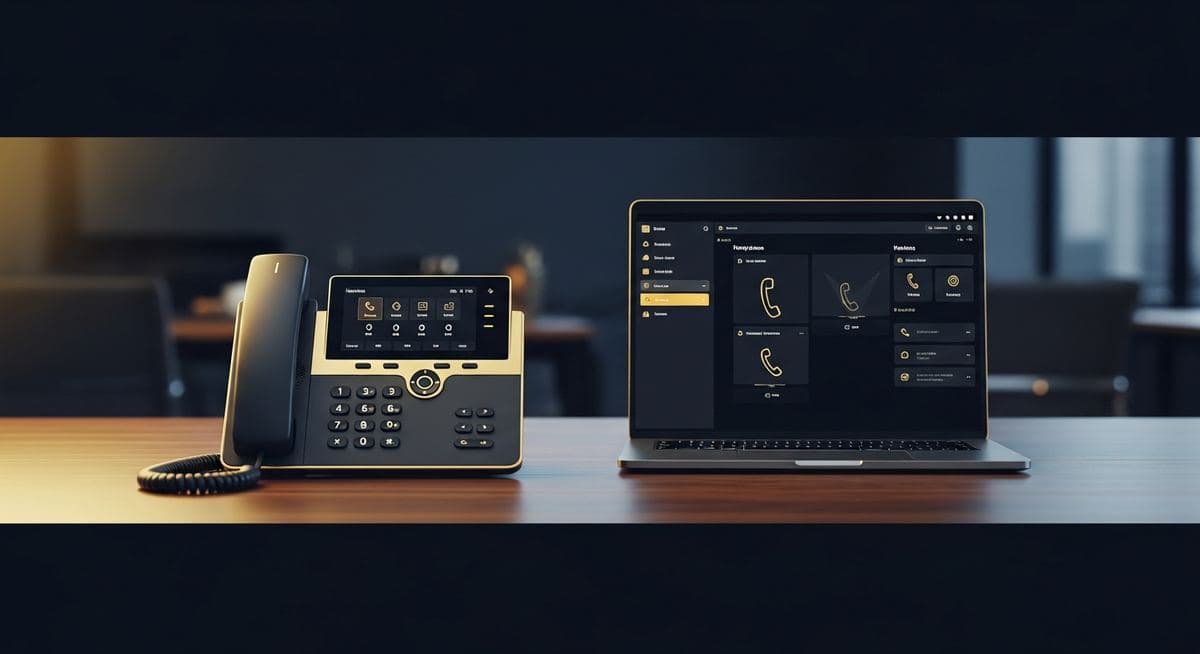
The IP phones vs. softphones question used to have a clear default — every employee gets a desk phone. That default is no longer right for most businesses. The newer reality is that the right endpoint mix varies by role, and getting the mix wrong creates either wasted hardware spend (over-provisioning desk phones to people who don't use them) or productivity friction (forcing softphone-only users into roles that need a quality dedicated handset). Here's a practical framework for deciding who gets which.
The Case for IP Desk Phones
IP desk phones have specific advantages that softphones don't replicate well:
- Call quality consistency — a dedicated handset on Ethernet has more predictable audio quality than a softphone on Wi-Fi competing with everything else on the device
- Always-ready availability — the phone is on, registered, and ready. No "open the app first"
- Hardware controls — physical buttons for hold, transfer, conference are faster than mouse-driven equivalents for high-volume callers
- Independence from the computer — desk phone keeps working through a computer reboot, software update, or VPN issue
- Visitor and shared-space use — conference rooms, break rooms, lobbies need phones that aren't tied to a specific user's computer
- E911 location accuracy — desk phones at known fixed locations are easier to register for emergency response than mobile softphones
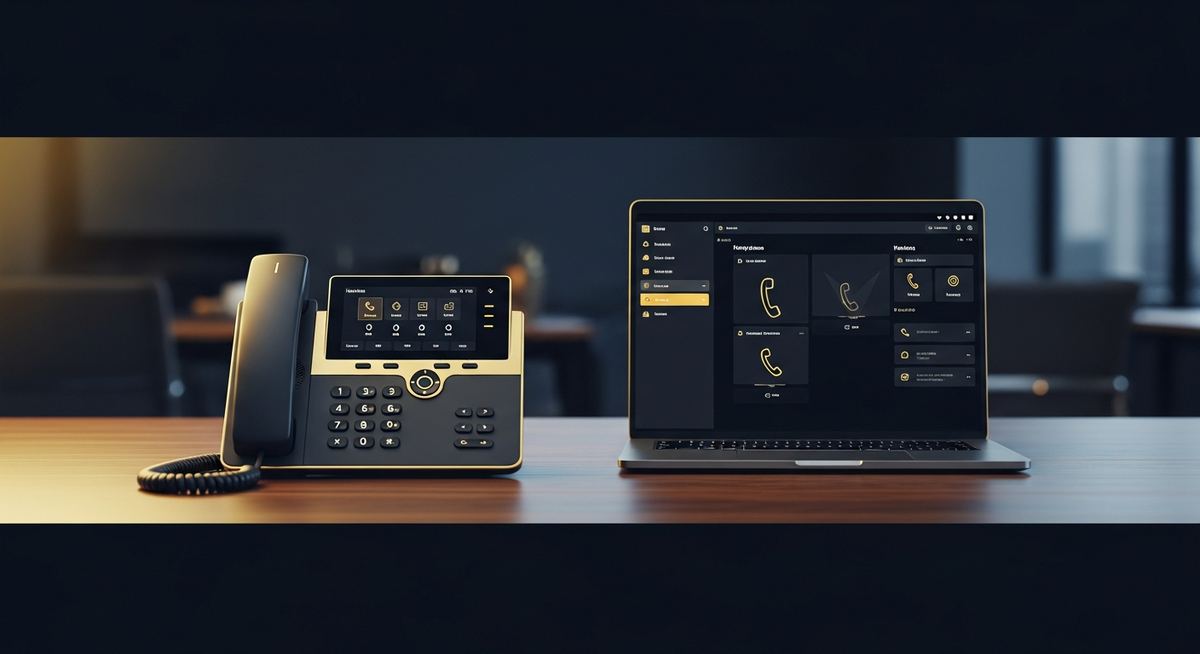
The Case for Softphones
Softphones (phone applications on PCs and mobile devices) have their own advantages:
- Mobility — your business number rings wherever you are, on whatever device makes sense
- Integration — click-to-dial from CRM, calendar awareness, message threads alongside calls
- Lower hardware cost — no $150-$300 desk phone per user
- Easier provisioning — assign a license, user installs the app, no shipping or installation labor
- Multi-line management — handling multiple ringing lines is simpler in software than across a button matrix on a desk phone
- Headset-friendly — particularly for users who already wear a headset for video meetings, a softphone fits naturally into that workflow
Mapping Roles to Endpoints
A practical role-by-endpoint mapping:
- High-volume callers (sales, customer service, support) — desk phone, often with a quality headset attached. Call quality matters, hardware controls speed up workflow.
- Knowledge workers in offices — softphone is usually sufficient. Most calls are scheduled meetings or quick conversations that don't justify desk-phone overhead.
- Mobile or field-based roles — softphone on mobile device, with the business number routed to it. Desk phone would be unused.
- Executives — depends on role. Some prefer desk phone for the reliability and "just works" factor. Others have shifted entirely to softphone.
- Receptionists and operators — desk phone, often with a larger display and more programmable buttons for call handling
- Conference rooms and shared spaces — dedicated conference phone or display-paired conferencing device
The mix at most businesses today is 30-50% desk phones, 50-70% softphone-primary. Five years ago it would have been the inverse.
Cost Comparison
Pure hardware: a quality IP desk phone runs $150-$300 with PoE; a higher-end model with color display and expansion modules can be $400-$600. Softphone licensing is usually included in the UCaaS per-user fee — no incremental cost. For a 100-person business, going softphone-heavy (say 60 softphone users, 40 desk phones) instead of all-desk saves $9,000-$18,000 in capital cost. That math drives the trend, but it's not the only consideration.
The Hybrid Approach Most Businesses End Up Using
The deployment pattern that works best in practice isn't one-or-the-other — it's role-appropriate. Heavy phone users and shared-space environments get desk phones. Knowledge workers and mobile-first roles get softphones. Everyone has the option of using both. The UCaaS platforms support this hybrid model natively — a user can have a desk phone, a PC softphone, and a mobile app all registered to the same identity, with calls ringing wherever makes sense. If you'd like help mapping the right endpoint mix for your team, a conversation with our team can scope it.
Leonidas is a managed IT services provider, cybersecurity consulting firm, and unified communications consultancy serving businesses across industries. We offer free 30-minute assessments. Contact us or call +1 (888) 790-8777.