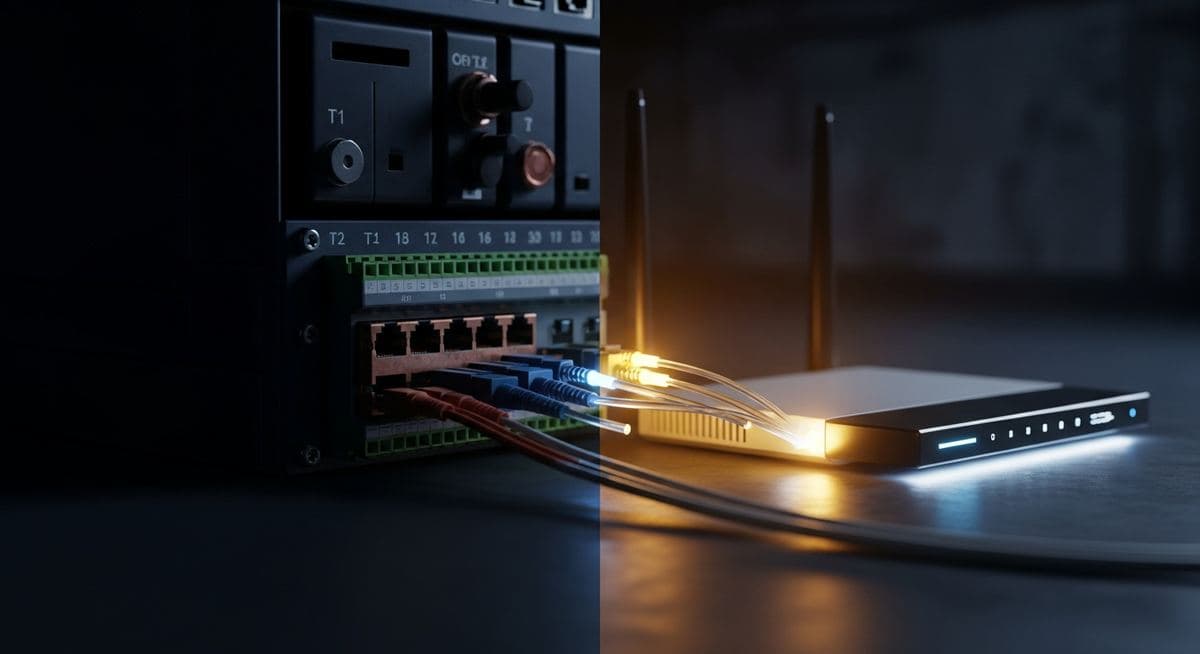
T1 Lines Are Dead: What Modern Businesses Use Instead — The T1 line was the gold standard of business connectivity for nearly two decades. Today, T1 line replacement has become one of the most straightforward telecom decisions a business can make — the alternatives are faster, cheaper, and in most cases more reliable than the dedicated circuits that came before.
What T1 Lines Were (And Why They Made Sense)
A T1 provided 1.544 Mbps of symmetric, dedicated bandwidth over copper at a predictable monthly cost. In the late 1990s and 2000s, that was genuinely fast. The real selling point was reliability: T1s came with carrier-grade SLAs, committed uptime, 4-hour repair windows, and service credits when things went wrong. Monthly costs of $400–$1,200 for a single T1 were considered normal and worth paying for businesses running VoIP or multi-site networks that needed symmetrical throughput.
Why T1s Disappeared
Two things killed the T1: fiber and economics. Fiber scaled bandwidth by orders of magnitude at lower cost per bit, making 1.5 Mbps look like a garden hose. Simultaneously, cable and fixed wireless providers improved business-grade offerings with SLAs and symmetric options previously only available on dedicated circuits. By the mid-2010s, carriers were actively migrating T1 customers. Today, a new T1 is essentially a niche product in locations fiber hasn’t reached — and even there, better alternatives exist.
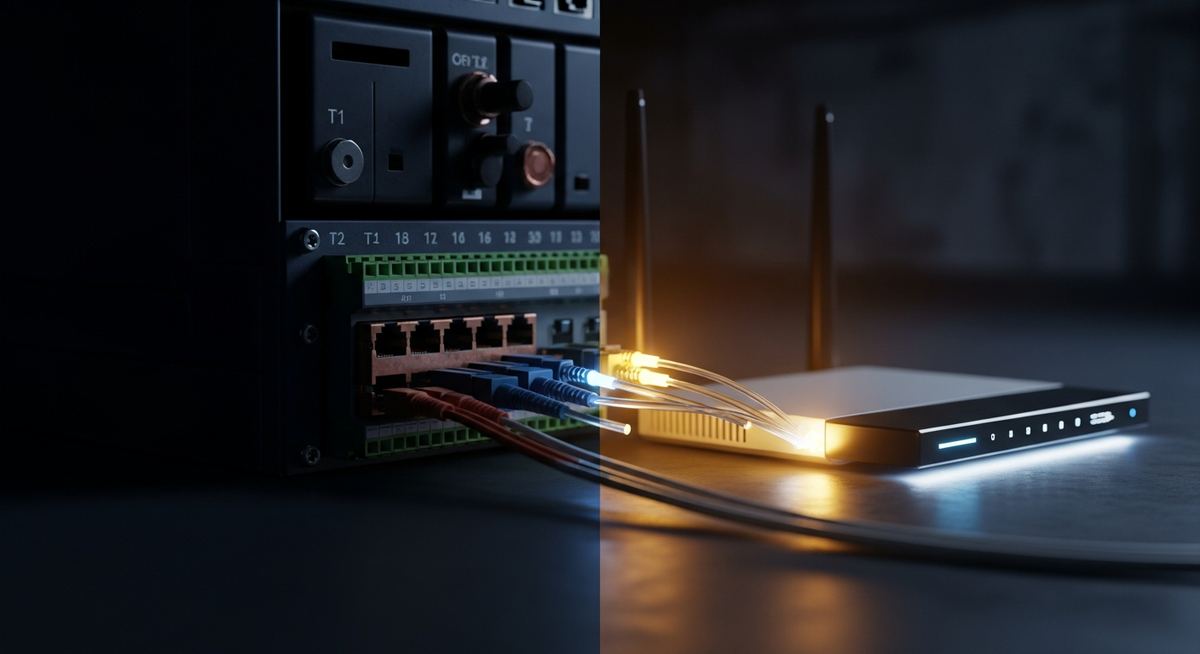
The Four Technologies That Replaced the T1
- Dedicated fiber (DIA) — Dedicated Internet Access over fiber delivers symmetric bandwidth from 10 Mbps to 10 Gbps with enterprise SLAs, typically at 30–60% of the cost of an equivalent T1 when normalized for speed. The correct choice for most businesses with fiber availability.
- Ethernet over Copper (EoC) — Where fiber isn’t available, bonded copper pairs can deliver 5–45 Mbps symmetrically with carrier SLAs. A reasonable upgrade for locations still on copper infrastructure.
- Fixed Wireless Access (FWA) — Business-grade wireless ISPs deliver 25–250+ Mbps to locations where fiber buildout hasn’t occurred. 5G FWA is expanding rapidly across industries with SLA-backed service in areas previously limited to cable or DSL.
- SD-WAN with broadband bonding — Combining two lower-cost broadband connections through an SD-WAN platform delivers effective uptime that exceeds most T1 SLAs at a fraction of the cost.
How to Choose the Right Option
Start with what’s available at your address, then filter by your actual bandwidth and SLA requirements. A retail location needing reliable POS and VoIP might be perfectly served by 50 Mbps fixed wireless with LTE failover. A law firm handling large document transfers and video depositions needs symmetric fiber with a committed SLA. One common mistake: over-buying on redundancy and under-buying on bandwidth. A single high-quality DIA connection with low-cost LTE backup often outperforms two midrange circuits at similar total cost.
Making the Transition Without Disruption
Provision the new connection in parallel, test it thoroughly with your voice and data workloads, then cut over. Keep the T1 active for 30 days post-cutover as a failback before canceling — the cost overlap is almost always worth it to avoid a hard-cutover failure on a business-critical circuit. Work with a telecom advisor who can pull quotes from multiple carriers simultaneously. DIY carrier management on a circuit migration is where businesses most commonly encounter delays and billing errors.
Leonidas is a managed IT services provider, cybersecurity consulting firm, and unified communications consultancy serving businesses across industries. We offer free 30-minute assessments. Contact us or call +1 (888) 790-8777.