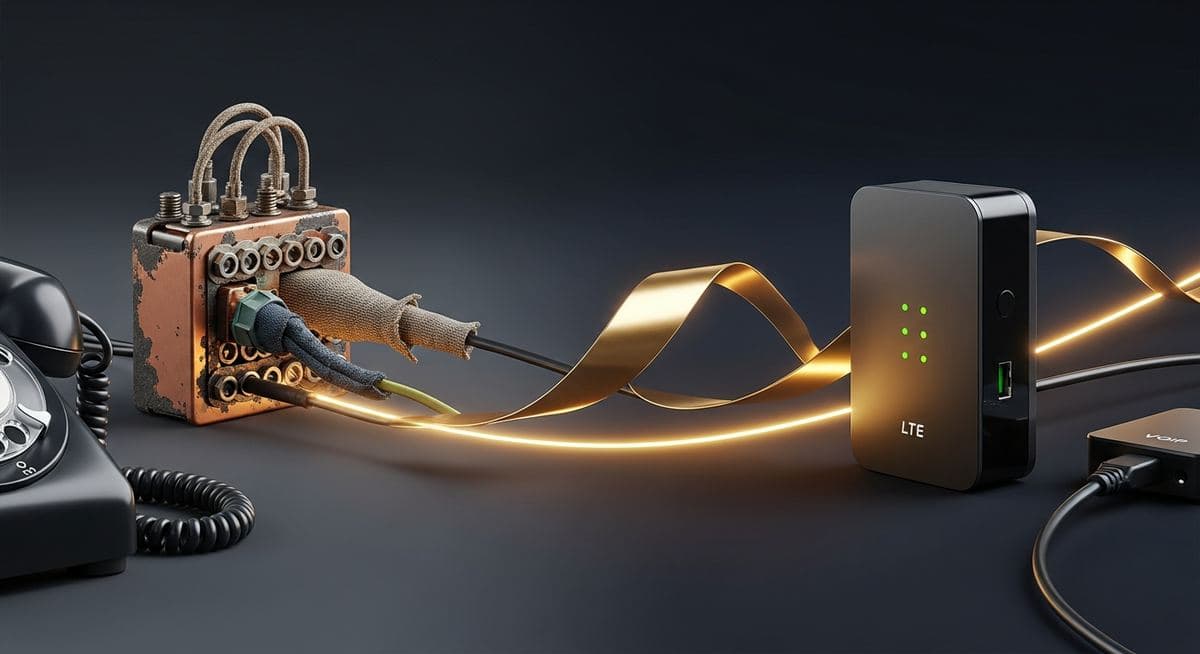
POTS line replacement has gone from "nice to have" to "your carrier is forcing it." Since the FCC discontinued mandatory POTS service obligations, traditional copper lines have been getting more expensive every year, in many regions doubling or tripling in price. But unlike a desk phone, you can't just swap a copper line for VoIP and call it done. POTS lines are still doing critical jobs that VoIP doesn't always cover — elevator emergency phones, fire alarm communicators, fax machines, security panels, and out-of-band management circuits. Here's how to replace each one without breaking compliance or stranding equipment.
Why POTS Is Going Away (and Why It's Costing You More Each Year)
When the FCC sunset the legacy POTS service obligations in 2022, carriers were no longer required to maintain copper-line infrastructure at regulated rates. The result has been steady de-investment in copper plant, paired with sharp rate increases on remaining lines. Many businesses are seeing single POTS lines billed at $150-$300 per month, with multi-line accounts pushing into thousands of dollars annually for circuits that handle one alarm panel or fax machine. The carriers' message is consistent: copper is going away, and the pricing reflects that.
What's complicated is that the equipment connected to those lines often has compliance requirements that aren't satisfied by just "switch to VoIP." Elevator phones, for instance, must connect to a monitored emergency line under ASME A17.1 code. Fire alarm communicators have specific requirements under NFPA 72 for primary and secondary signaling paths. A naive cutover can break code compliance without anyone noticing until an inspection.
The Four Categories of POTS Replacement
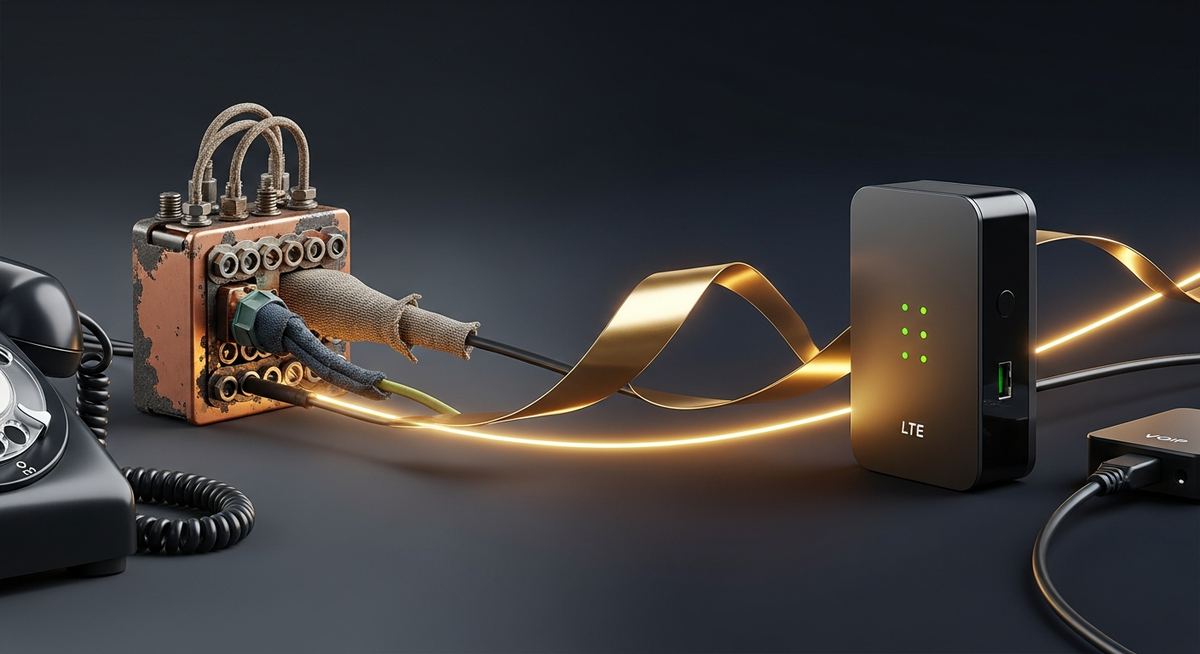
Not every POTS line gets replaced the same way. The right replacement depends on what the line is doing:
- Voice lines (basic business phone) — these are the easiest. A managed VoIP or UCaaS service replaces them directly with better features at lower cost. The migration path is well-trodden.
- Elevator phones — require a cellular-backed VoIP solution that meets ASME A17.1. Specialized providers like Kings III or AT&T's elevator phone service handle this; a generic SIP trunk usually doesn't satisfy the code.
- Fire alarm communicators — must use a UL-listed digital alarm communicator that the alarm panel manufacturer has approved. Cellular communicators (5G-LTE) are the dominant replacement; some buildings dual-path with IP plus cellular.
- Fax lines and analog modems — for fax, most businesses are better served by an email-to-fax service (HIPAA-eligible if the use case is healthcare). For modems handling out-of-band management, cellular routers with serial console support are the modern replacement.
The Cost Math Almost Always Favors Replacement
If you're paying $200 per month for a single POTS line, that's $2,400 per year. A cellular elevator phone solution typically runs $30-$50 per month with monitoring included. A UL-listed cellular fire alarm communicator is a one-time hardware cost (often $400-$800) plus $25-$40 per month for the cellular plan. Even accounting for installation labor and the parallel-run period during migration, payback is typically inside 12 months.
The other cost is downside risk. Carriers are de-investing in copper, which means repair response times on POTS-related outages are getting longer. We've seen organizations report multi-week wait times for copper line repairs that used to be next-day. If your fire alarm signaling path or elevator phone goes down, you have a code-compliance problem until it's restored. Modern alternatives don't depend on a technician driving to a central office that increasingly few people staff.
How to Sequence the Migration
The order matters. A typical POTS replacement project at Leonidas runs roughly as follows: first, audit every POTS line in the building and identify what it connects to (this is non-trivial — labels are often wrong or missing). Second, classify each line by replacement category. Third, install replacements for life-safety circuits first (elevator phones, fire alarms) since those have the longest test/certification cycles. Fourth, migrate voice lines and fax. Finally, after all alternatives have been tested and certified in parallel for a verification period, disconnect the copper.
One mistake we see frequently: customers ask the carrier to disconnect copper before the replacement is certified. The carrier obliges, the inspector shows up six months later, the elevator phone fails the test, and now there's a compliance violation with no easy fix. Always run parallel through certification.
Leonidas is a managed IT services provider, cybersecurity consulting firm, and unified communications consultancy serving businesses across industries. We offer free 30-minute assessments. Contact us or call +1 (888) 790-8777.