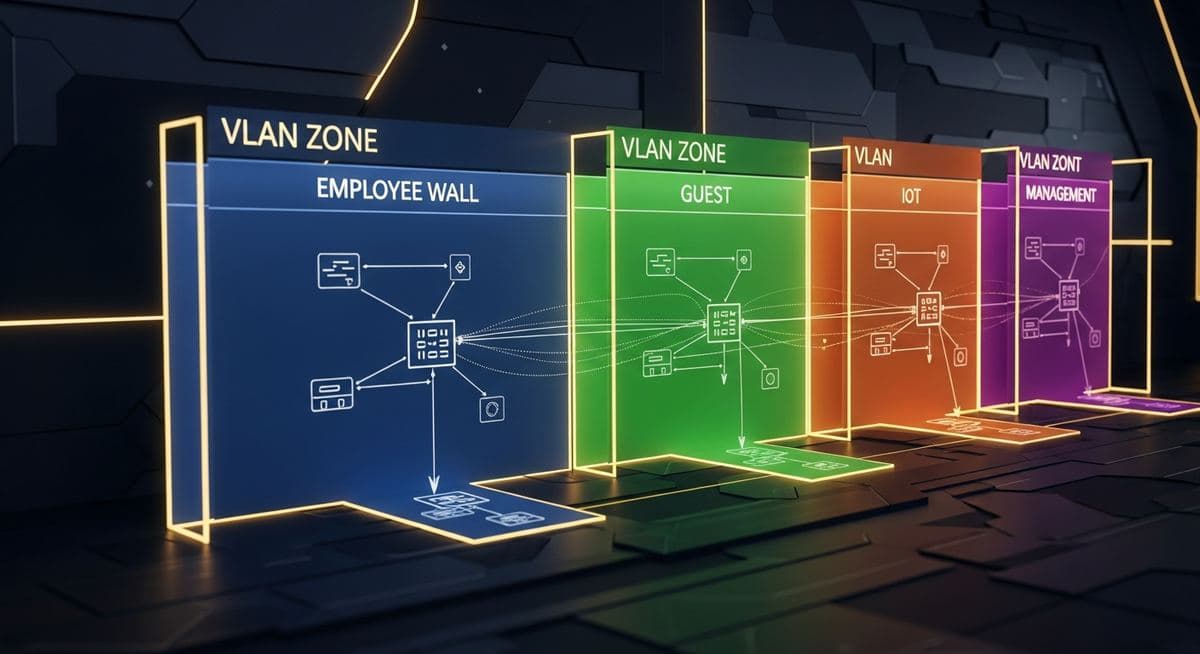
Network segmentation is the practice of dividing your network into separate zones so that compromise of one zone doesn't automatically mean compromise of the rest. It's one of the highest-leverage security controls a business can implement, and it's still missing or poorly executed at the majority of SMBs we audit. The good news: meaningful segmentation doesn't require enterprise tooling. The bad news: it requires intentional design, not just plugging in VLANs.
Why Segmentation Matters
Flat networks — where everything on the LAN can talk to everything else — were the default for decades because they were simple to manage. They're also the reason ransomware spreads from a single compromised laptop to file servers, domain controllers, and backup systems within minutes. Segmentation is the architectural answer: even if an attacker gets onto the network, segmentation limits how far they can go.
The same principle applies to compliance scope. If your point-of-sale system is on the same flat network as everything else, your entire network is in PCI scope. If it's properly segmented, only the PCI segment is in scope.
The Zones That Matter
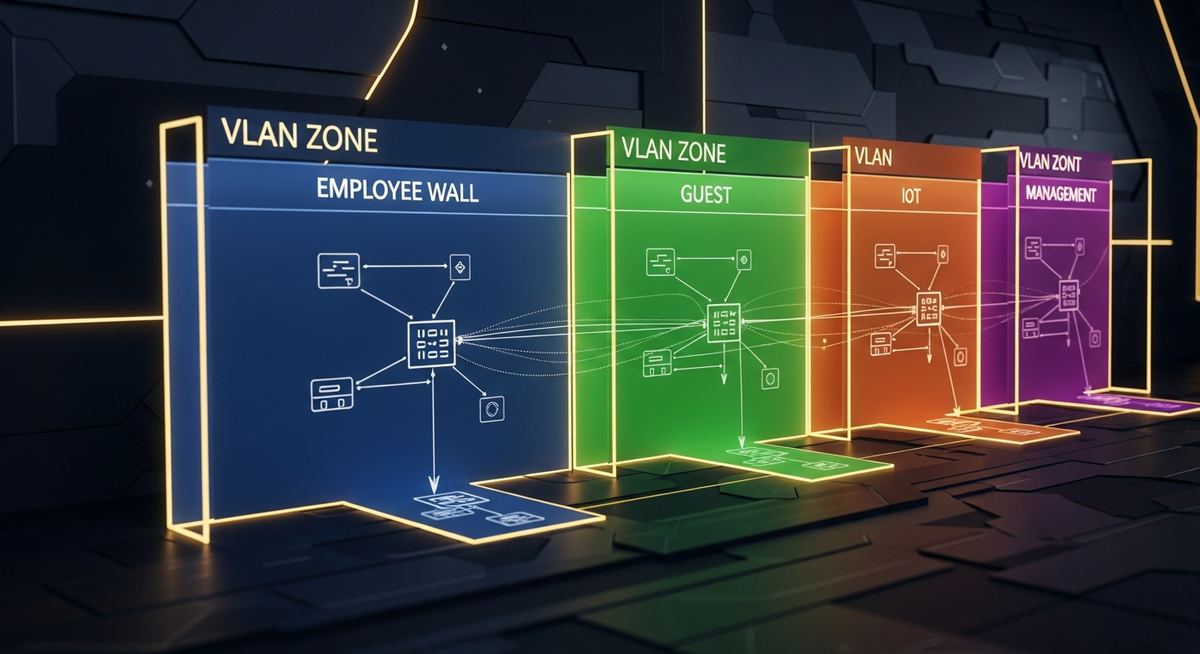
For most SMB and mid-market businesses, the network should be segmented into at least these zones:
- User network — employee laptops, desktops, BYOD
- Server network — on-premises servers, NAS, infrastructure resources
- Management network — admin interfaces for switches, firewalls, hypervisors, storage
- IoT/OT network — cameras, building automation, printers, badge readers, anything embedded
- Guest network — visitor and contractor devices, fully isolated from corporate resources
- VoIP network — phone traffic, isolated for QoS and security
- DMZ — any internet-exposed resources, isolated from the internal network
Each zone has its own VLAN (or VRF in larger environments), and traffic between zones is explicitly controlled by firewall rules. Default-deny between zones, with explicit allow rules for the legitimate cross-zone communication patterns.
Where Segmentation Goes Wrong
Common segmentation failures:
- VLANs without firewall enforcement — devices in different VLANs but with permissive routing between them. The VLAN exists but doesn't provide isolation.
- Management interfaces accessible from user network — admin consoles reachable from any user device, defeating the purpose of management segregation
- IoT devices on the user network — printers, cameras, smart devices sharing the same broadcast domain as user laptops
- "Temporary" cross-zone rules that became permanent — once a rule is added, it usually doesn't get removed
- Inadequate monitoring of cross-zone traffic — even with proper segmentation, you should know what's crossing zone boundaries and why
- Guest network with internal access — guest Wi-Fi that can reach corporate resources defeats the isolation
Implementing Without Buying Enterprise Gear
You don't need a $50,000 firewall to get meaningful segmentation. Practical implementation approaches:
- VLAN-aware switches with VLAN trunking to a firewall handling inter-VLAN routing. Most business-grade switches support this.
- Modern firewall with multiple zones configured. Even SMB firewalls from Fortinet, Sophos, WatchGuard, Cisco Meraki, etc. support this.
- Cloud-managed network platforms (Meraki, Mist) make segmentation policy easier to design and maintain
- For larger deployments, microsegmentation tools like Illumio, Guardicore, or VMware NSX provide more granular control
The technology budget for SMB segmentation is usually modest. The cost is mostly in the design and operational discipline.
How to Start If You Have a Flat Network
For businesses on a flat network today, the migration path doesn't have to be a single big project. A practical sequence: identify the zones and document the legitimate cross-zone communication patterns, isolate management interfaces first (lowest-disruption change with high security value), separate IoT and printers from the user network, build a guest network with proper isolation, then segment user from server traffic. Each step delivers value independently and builds toward a fully segmented architecture.
If you're scoping network segmentation for your environment, a conversation with our team can map the work and the priority sequence.
Leonidas is a managed IT services provider, cybersecurity consulting firm, and unified communications consultancy serving businesses across industries. We offer free 30-minute assessments. Contact us or call +1 (888) 790-8777.