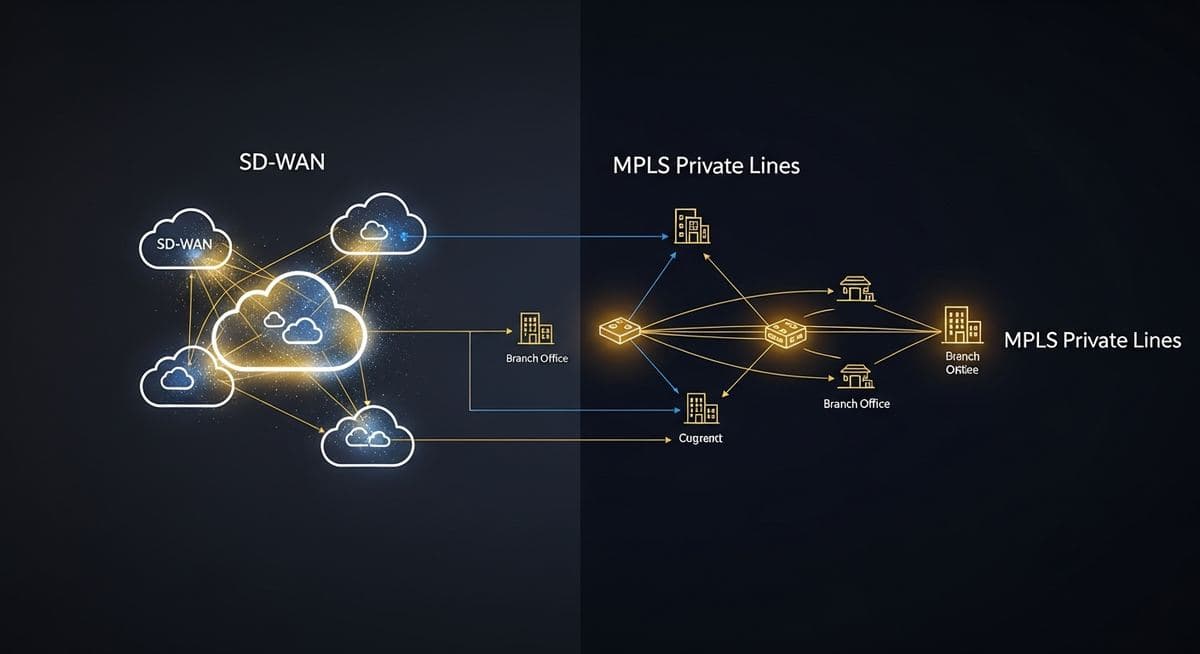
SD-WAN vs. MPLS is the wide-area network architecture decision facing most multi-location businesses today. MPLS was the gold standard for two decades; SD-WAN has been the disruption story for the past five years. The honest answer is that both have legitimate places, but the cost-benefit ratio has shifted substantially toward SD-WAN for the majority of mid-market deployments. Here's a practical comparison.
What Each Technology Does
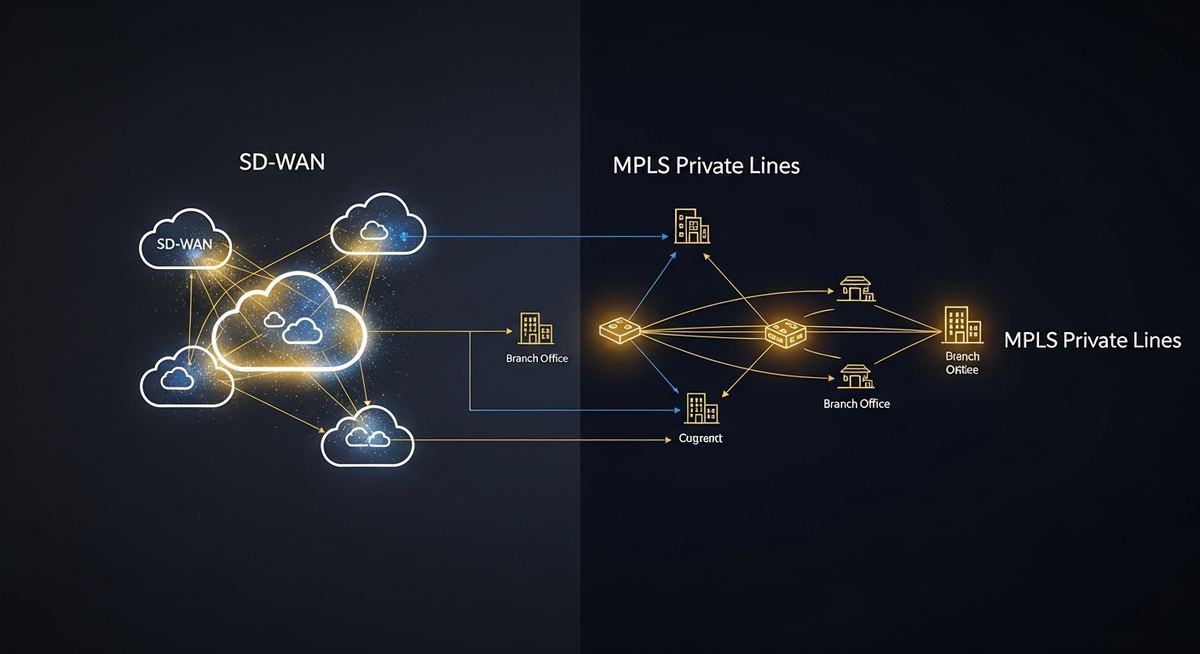
MPLS (Multiprotocol Label Switching) is a private network service from a carrier that connects multiple business locations on a managed, performance-guaranteed circuit. Traffic between locations stays within the carrier's network, with end-to-end SLAs on latency, jitter, and packet loss. The architectural pattern: every location connects to the same private network, the network handles the routing, and the customer doesn't manage the underlying paths.
SD-WAN (Software-Defined Wide Area Network) is an overlay technology that runs on top of multiple underlying transports — typically combining commodity internet circuits, fiber, cellular, or any other connectivity available. SD-WAN devices at each location measure the performance of available paths in real time and route traffic over the best path for each application. The architectural pattern: each location has multiple connections, software decides which to use, and the policy is centrally managed.
Where MPLS Still Wins
A few scenarios where MPLS remains the better choice:
- Latency-critical applications with strict SLA requirements that internet-based paths can't reliably meet
- Real-time control or industrial workloads where any deviation from baseline latency causes operational problems
- Regulatory environments requiring fully private paths between locations with no public internet involvement
- Locations where commodity internet quality is genuinely poor, and the underlying transports SD-WAN would use can't deliver acceptable performance
For most business workloads — voice, video, SaaS, file transfer, web traffic — modern internet paths meet the performance requirements that used to require MPLS.
Where SD-WAN Wins
The cases where SD-WAN is the clearly better answer:
- Multi-location businesses with cloud-heavy workloads — SD-WAN's local internet breakout is more efficient than backhauling cloud traffic through MPLS
- Cost optimization — SD-WAN over commodity internet typically costs 30-60% less than equivalent MPLS bandwidth
- Resilience through diversity — combining multiple carriers and transport types produces better uptime than any single-carrier MPLS
- Rapid deployment of new locations — SD-WAN can stand up with any available internet; MPLS provisioning often takes months
- Application-aware routing — voice over the lowest-latency path, bulk transfer over the highest-bandwidth path, all automatically
The Cost Comparison
Direct cost comparison varies by market and bandwidth tier. Rough averages for 100Mbps connectivity to a single business location: MPLS runs $1,500-3,000 per month depending on geography. Commodity business fiber runs $400-800 per month. SD-WAN device and management overhead runs $100-300 per month per location. Net effect: SD-WAN total cost is typically 40-60% lower than MPLS for equivalent functional capability.
The savings get larger as you scale to more locations. A multi-location organization can save tens of thousands of dollars per month moving from MPLS to SD-WAN.
What the Migration Looks Like
SD-WAN migrations from existing MPLS networks are well-trodden territory. Typical sequence: provision new internet circuits at each location, deploy SD-WAN devices, run in parallel with existing MPLS until performance is validated, gradually shift traffic class by class to SD-WAN, decommission MPLS after parallel validation period. The migration usually takes 3-9 months depending on number of sites.
If you're evaluating SD-WAN vs. MPLS for your network, a conversation with our WAN team can map the specific cost and operational comparison against your environment.
Leonidas is a managed IT services provider, cybersecurity consulting firm, and unified communications consultancy serving businesses across industries. We offer free 30-minute assessments. Contact us or call +1 (888) 790-8777.