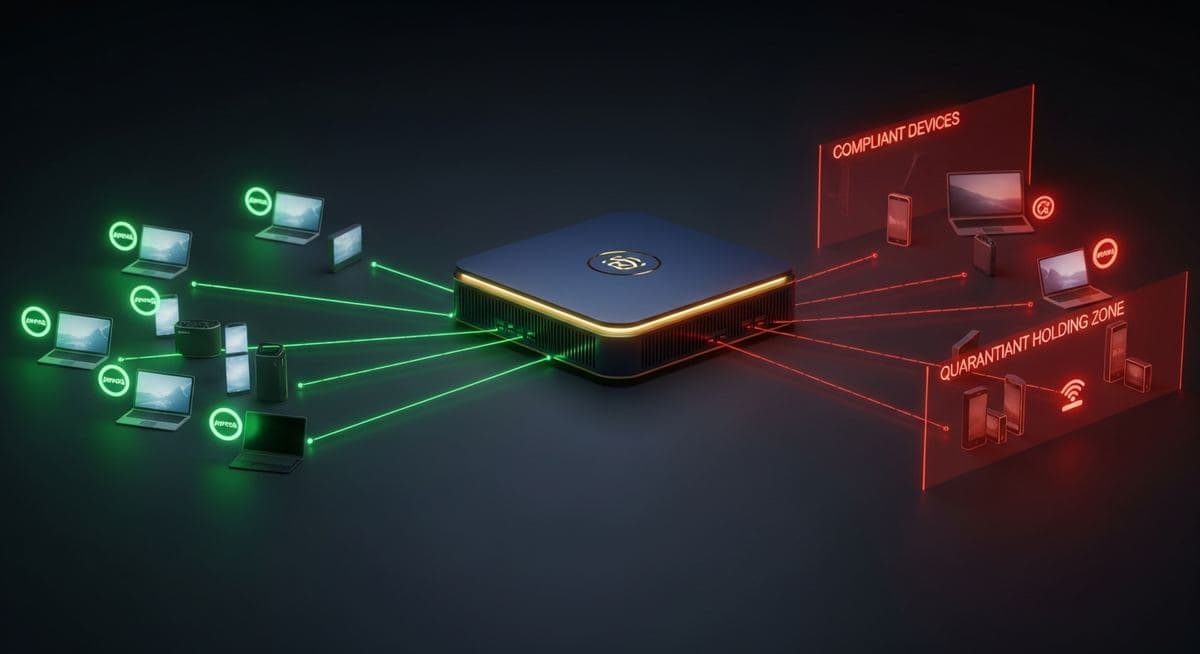
Network Access Control (NAC) is the discipline of knowing what's on your network and controlling what each device is allowed to do. Modern NAC goes beyond "block unknown devices" to include device posture validation, dynamic policy enforcement, and continuous re-evaluation as device state changes. For businesses with diverse device types — laptops, IoT, BYOD, contractors — NAC is the layer that prevents the network from becoming a free-for-all.
The Problem NAC Solves
Without NAC, business networks become accumulation points for whatever devices happen to plug into them. A contractor's laptop, an IoT camera, an employee's personal tablet, a vendor's diagnostic device — all get the same network access as managed corporate endpoints. This creates several specific risks: malware on unmanaged devices spreading to corporate systems, sensitive data flowing to devices the business doesn't control, shadow IT proliferating because there's no enforcement, and compliance scope expanding to cover anything that touched the network during an audit period.
NAC addresses these by gating network access — only authorized devices in known-good state get on, and they get access only to what their identity and role warrant.
What Modern NAC Includes
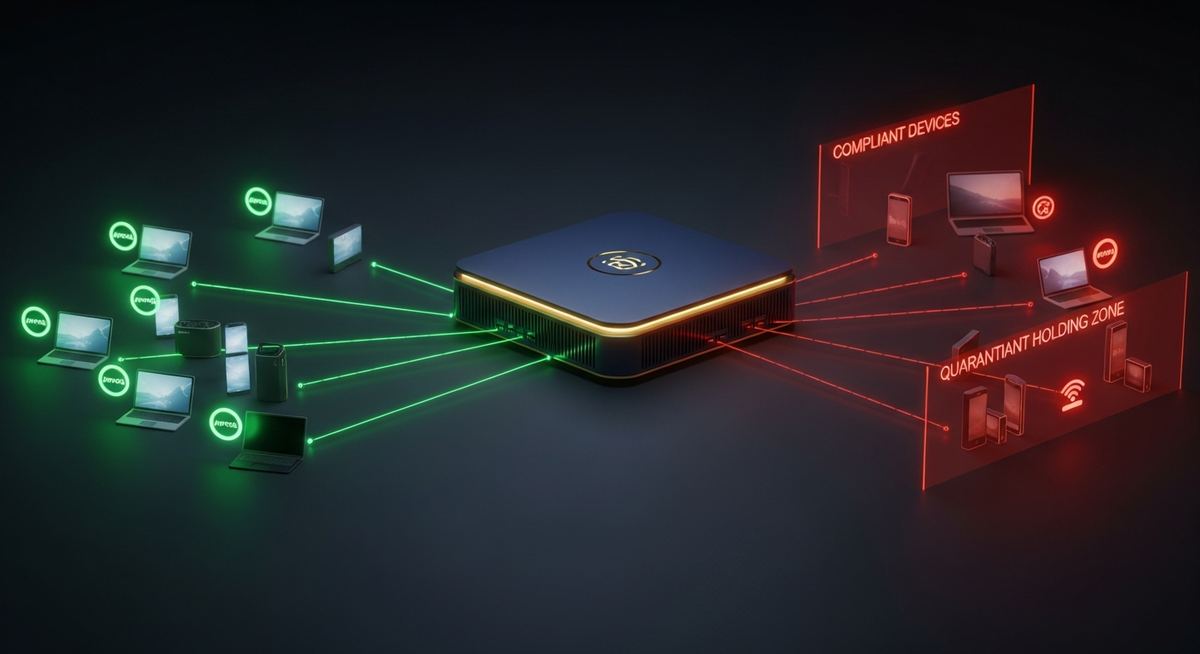
A modern NAC deployment typically covers:
- Device authentication — 802.1X-based authentication where supported, plus MAC authentication bypass for devices that can't speak 802.1X
- Device posture assessment — checking that devices have current OS patches, EDR running, encryption enabled, etc.
- Role-based policy — different access for different device categories (corporate endpoint, BYOD, IoT, contractor, guest)
- Dynamic VLAN assignment — placing devices on appropriate network segments based on their identity and posture
- Guest network management — sponsored guest access with proper isolation
- Profile-based identification — automatically identifying device types from network behavior, useful for IoT and BYOD
- Continuous re-evaluation — re-checking device posture periodically, not just at connection time
The NAC Vendor Landscape
The main platforms in current use:
- Cisco ISE (Identity Services Engine) — enterprise-grade, complex, capable
- Aruba ClearPass — strong NAC platform integrated with HPE Aruba networking
- Fortinet FortiNAC — NAC integrated with Fortinet security platform
- Forescout — independent platform with strong IoT identification capabilities
- Cloud-managed alternatives — Meraki, Mist, and others offer NAC capabilities within their cloud management platforms
For SMB and mid-market businesses, the cloud-managed approach (NAC capabilities within Meraki, Mist, or similar) is often more practical than standalone enterprise NAC platforms, which are designed for larger and more complex environments.
The Deployment Considerations
NAC deployments at SMB scale work well when:
- The network already has segmentation in place that NAC can leverage for policy enforcement
- Identity infrastructure is in good shape — NAC depends on knowing who's authenticating
- Device inventory is reasonably current — surprises during NAC rollout slow the project
- There's executive buy-in for the inevitable friction during rollout (some devices won't get on the network until issues are addressed)
Common deployment mistake: turning on enforcement mode broadly without enough discovery time first. Devices that should be authorized but aren't yet in policy get blocked, business operations get disrupted, and the project loses support. The right sequence is to run in monitoring mode for weeks before enabling enforcement, identifying and remediating gaps before they cause outages.
When NAC Is Worth the Investment
The signals that NAC is the right next investment: device diversity is high (lots of IoT, BYOD, contractors), compliance requirements explicitly call for access control (HIPAA, CMMC, PCI), past incidents involved unmanaged devices, network segmentation alone isn't catching the right traffic patterns, or audits have flagged "unknown devices" as a finding.
For businesses without those drivers, NAC may be overkill. Strong network segmentation, identity-based access controls at the application layer, and good device management can deliver much of the same security posture without NAC's operational overhead. If you're scoping NAC for your environment or evaluating whether you need it, a conversation with our team can frame the decision.
Leonidas is a managed IT services provider, cybersecurity consulting firm, and unified communications consultancy serving businesses across industries. We offer free 30-minute assessments. Contact us or call +1 (888) 790-8777.