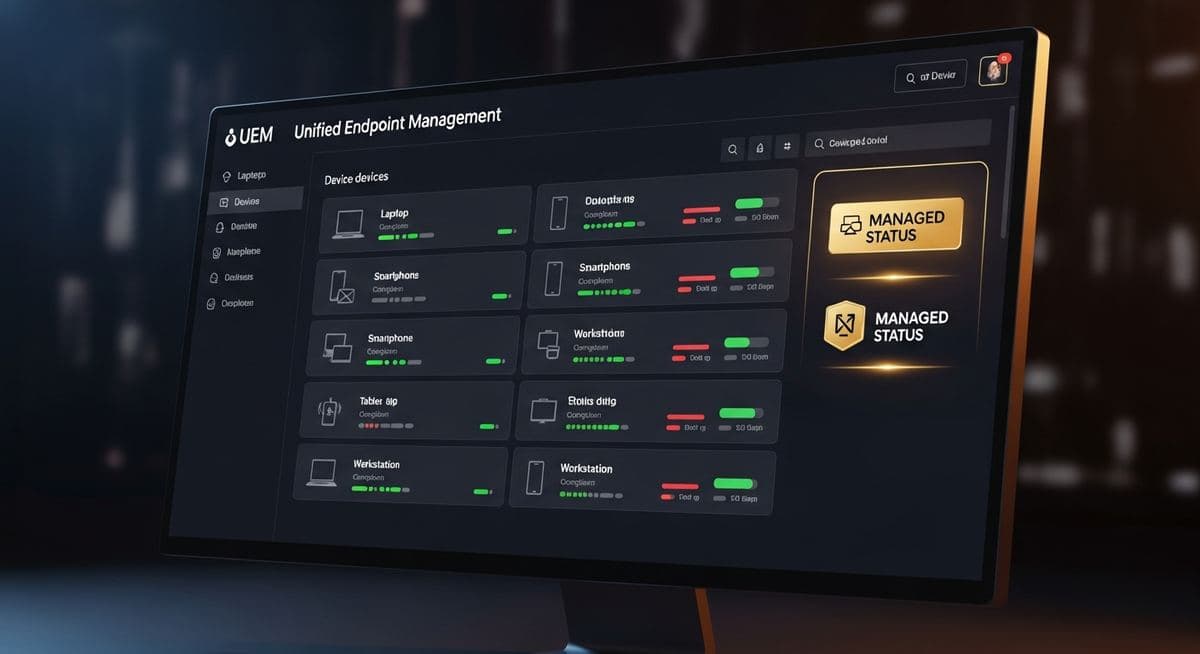
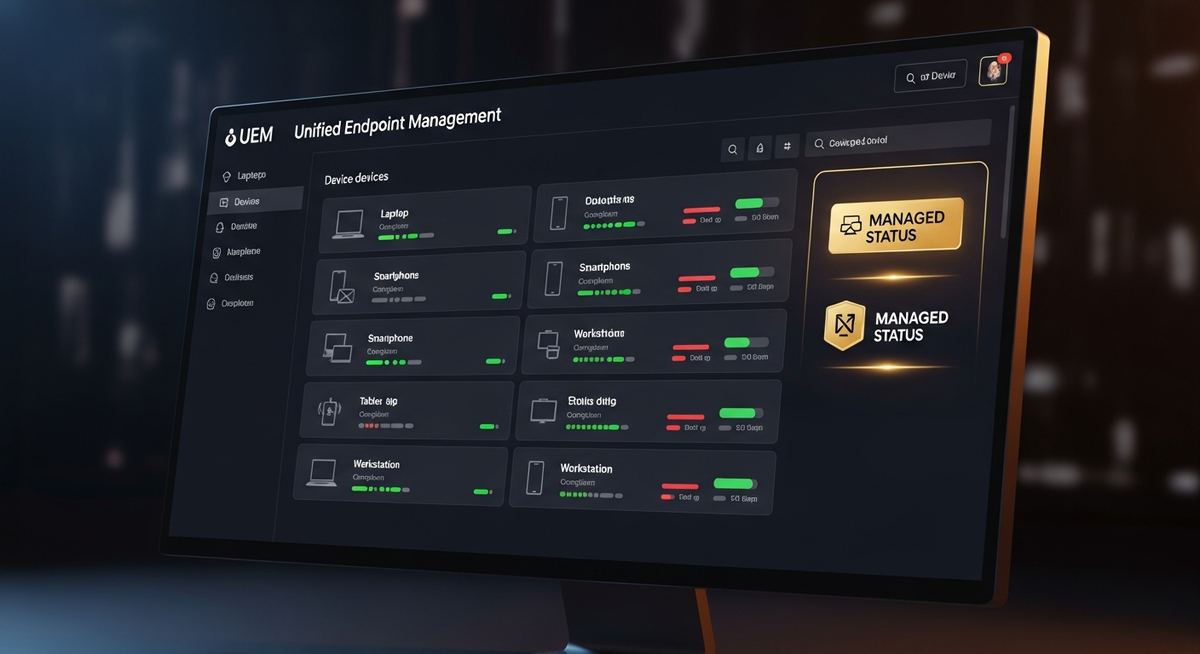
Unified endpoint management (UEM) is the evolution of mobile device management (MDM) plus traditional desktop management into a single platform that handles everything with a screen — laptops, desktops, tablets, phones, and increasingly rugged devices and kiosks. The pitch is operational consolidation: one console instead of three, one set of policies instead of three, one team trained on one platform instead of three. The reality at most SMBs is more nuanced. Here's an honest read on what UEM delivers and when it's worth the investment.
What UEM Actually Replaces
Most businesses with under 200 endpoints don't have explicit MDM, desktop management, and mobile management as separate platforms. They have a patchwork: Microsoft Intune (or another MDM) for mobile, Group Policy plus some flavor of RMM for Windows desktops, and whatever Mac management was bolted on for the design team's MacBooks. UEM replaces that patchwork with a single platform that applies policy, manages updates, deploys software, and reports posture across all device categories.
The leading UEM platforms are Microsoft Intune (with Endpoint Manager), Jamf (Mac-strong), VMware Workspace ONE, and Hexnode for SMB-friendly pricing. Each has different strengths depending on device mix and existing ecosystem.
What You Gain
Real benefits when UEM is well-deployed:
- Consistent policy across device types — the same password and encryption requirements applied to laptops, tablets, and phones
- Reduced operational overhead — one console to learn, one place to look when something breaks
- Zero-touch provisioning — new devices arrive at the user, sign in, and self-configure from policy
- Better visibility — single source of truth on what devices the business owns and what state they're in
- Conditional access integration — access decisions can incorporate device compliance state, not just identity
- Remote wipe capability — for any device class, including BYOD scenarios with selective wipe of business data
What You Don't Get from UEM Alone
UEM isn't a replacement for everything else in endpoint operations. It doesn't replace EDR/MDR security tooling (UEM enforces policy; EDR detects active threats). It doesn't replace patch management for third-party apps (most UEM platforms handle OS patches well but supplemental tools cover third-party app vulnerabilities better). It doesn't replace remote support tools (UEM consoles can push policy and trigger actions, but real-time remote control of an endpoint typically uses a separate tool). Plan for UEM as one layer in a broader endpoint operations stack, not as the whole stack.
The Deployment Reality
UEM deployments at SMBs typically run 6-12 weeks from kickoff to full enrollment. The work breaks down roughly as:
- Discovery and policy design — what policies will apply to which device groups
- Platform configuration — setting up the UEM environment, integrating with identity, configuring compliance rules
- Pilot enrollment — small group of devices enrolled and policies validated
- Phased rollout — broader enrollment, with sequencing by device type and user impact
- User education — explaining what UEM does, what it sees, and what it doesn't see (especially important for BYOD scenarios)
Rushed UEM deployments produce user pushback when policies surprise people. Taking time on the policy design and user communication phases saves time on the back end.
When It's Worth It
The signals that UEM is the right next investment: device count is large enough that operational patchwork is costing time (typically 50+ endpoints), security or compliance requirements that need consistent policy enforcement across device types, growing share of mobile devices in business workflows, or hybrid work patterns where users connect from arbitrary locations and devices. Below that threshold, the operational savings often don't justify the platform cost and deployment effort.
If you're scoping a UEM project for your environment, a conversation with our team can map your current state against the right deployment approach.
Leonidas is a managed IT services provider, cybersecurity consulting firm, and unified communications consultancy serving businesses across industries. We offer free 30-minute assessments. Contact us or call +1 (888) 790-8777.