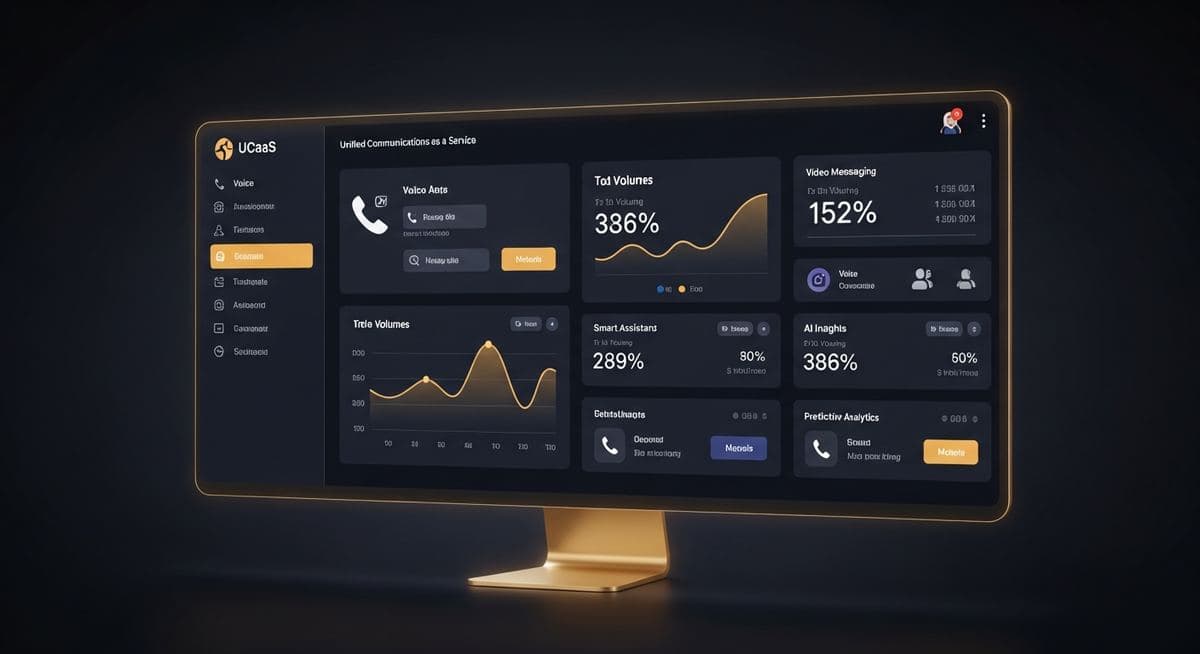
UCaaS trends in 2026 reflect a market that's matured past land-grab and entered consolidation. The vendor list is shorter than it was three years ago, the feature gaps between platforms have narrowed, and the conversation has shifted from "which vendor wins" to "which deployment pattern fits this business." A few specific trends are worth understanding because they'll shape the buying decisions of any business looking at unified communications this year.
Trend 1: Microsoft Teams Phone Is Eating the Mid-Market
Microsoft Teams Phone has consolidated significant market share by being "good enough" for many businesses that were already Teams customers. For organizations where Teams is the collaboration hub anyway, adding Teams Phone is operationally simpler than running a separate UCaaS platform alongside it. The trade-off: Teams Phone's voice feature set is narrower than dedicated UCaaS platforms in specific areas (advanced call analytics, contact center capabilities, certain telephony features), and the licensing math sometimes favors a dedicated UCaaS provider over Teams Phone Standard licenses.
The 2026 reality is that mid-market businesses now evaluate Teams Phone against RingCentral or Zoom Phone on equal footing — not as a default winner, but as a legitimate alternative whose value depends on the specific feature requirements.
Trend 2: AI Features Are Table Stakes
Every major UCaaS vendor has shipped AI capabilities — call transcription, meeting summarization, sentiment analysis on customer calls, real-time translation, automated coaching suggestions. The differentiation is shifting from "does it have AI" to "how well does the AI work in your specific environment." Practical evaluation focuses on accuracy of transcription on industry-specific terminology, quality of meeting summaries on calls with multiple speakers, and whether the AI features integrate with the business applications where the insights actually need to land.
For most SMB and mid-market businesses, the AI features are net-positive — they save time on meeting follow-up and create searchable records of voice conversations. For regulated industries (healthcare, legal, financial services), the data governance and retention implications of AI-generated transcripts need careful evaluation before turning the features on broadly.
Trend 3: Contact Center Is Converging With UCaaS
The line between UCaaS (employee communications) and CCaaS (contact center) used to be clean. It's blurring fast. Many businesses now want a single platform that supports their general workforce on UCaaS features and their customer-facing team on contact center features — agent licenses on the same platform as everyone else, with omnichannel queues, IVR, and call recording integrated into the same admin console. Vendors are responding: RingCentral has Contact Center, Zoom has Contact Center, NICE acquired the Five9 capabilities pieces it lacked, Microsoft is steadily extending Teams toward contact center scenarios.
Trend 4: Compliance and Data Residency Pressure Is Rising
Customers are increasingly asking UCaaS vendors specific questions about where data is stored, who has access to it, how long recordings are retained, and how the vendor handles legal hold and discovery. For businesses serving regulated industries or operating internationally, vendor selection now depends partly on data-handling capabilities that weren't on the evaluation rubric a few years ago. Vendors that can offer regional data hosting, HIPAA-eligible configurations, and detailed audit logs have an advantage with those buyers.
What Businesses Should Do Now
For businesses on a current UCaaS contract approaching renewal, the right question for 2026 isn't "which UCaaS vendor should we switch to" — most platforms are now competitive enough that switching for a marginal feature improvement isn't worth the migration cost. The better questions are:
- Is our current platform's AI feature set delivering meaningful productivity gain?
- Are we using contact center features that would benefit from a more integrated platform?
- Has our compliance posture shifted such that data residency or audit capabilities now matter?
- Are we paying for tiers and features we don't actually use?
The answers usually point to either tier optimization within the current platform or a migration with a clear strategic reason. A conversation with our team can scope where your current UCaaS sits against the current market.
Leonidas is a managed IT services provider, cybersecurity consulting firm, and unified communications consultancy serving businesses across industries. We offer free 30-minute assessments. Contact us or call +1 (888) 790-8777.