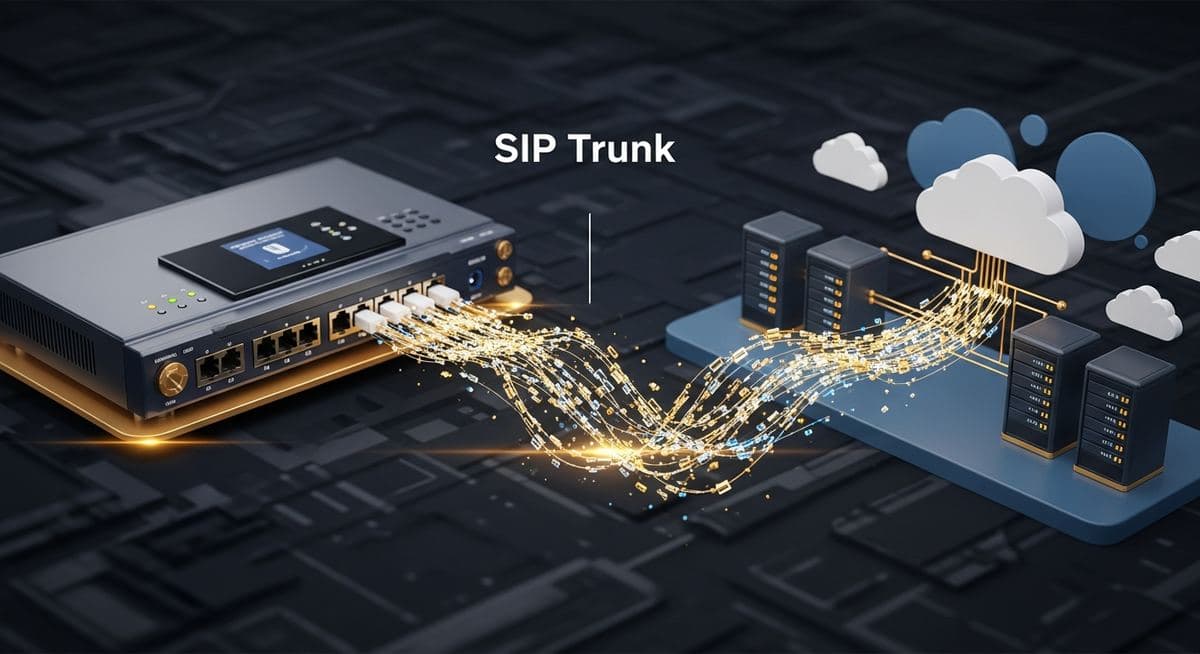
SIP trunking is the technology that connects modern business phone systems to the public phone network. It replaced traditional ISDN PRI lines and analog trunks at most businesses years ago, but it's still poorly understood — both by businesses buying it and by businesses who have it but don't know what they're paying for. Here's a plain-English explanation of what SIP trunking does, when it's the right answer, and where the common configuration mistakes are.
What SIP Trunking Is
SIP (Session Initiation Protocol) trunking provides voice connectivity between a business's IP-based phone system and the public switched telephone network (PSTN). Where legacy phone service used dedicated copper or T1 lines from a carrier to the business's PBX, SIP trunks deliver the same connectivity over data networks. The "trunk" carries multiple simultaneous calls — typically 4 to 200+ calls per trunk depending on the configuration.
For businesses with an on-premises IP-PBX or session border controller, SIP trunking is the path to the outside world. For businesses on cloud UCaaS platforms, SIP trunking exists inside the vendor's infrastructure but doesn't need direct management. The dividing line is who's running the phone system — your business or the cloud provider.
The Pricing Model
SIP trunk pricing typically includes:
- Per-channel monthly fee — for each simultaneous call capacity ($15-30 per channel is common)
- Per-DID monthly fee — for each individual phone number ($0.50-2 per number)
- Per-minute usage rates — for outbound calls, often free for inbound, with rates varying by destination
- Toll-free service — separate pricing for inbound toll-free numbers
- International rates — per-minute rates for international destinations, varying widely by country
Compared to legacy PRI service ($400-800 per month for a 23-channel circuit plus per-minute fees), SIP trunking is typically 30-60% cheaper at equivalent capacity. Compared to cloud UCaaS where calling is bundled into per-user fees, SIP trunking can be more or less cost-effective depending on call volume and user count.
When SIP Trunking Is the Right Choice
Scenarios where SIP trunking is the right answer:
- You run an on-premises IP-PBX and need PSTN connectivity for it
- High call volume environments — contact centers, high-call-volume sales teams where per-channel pricing beats per-user UCaaS
- Hybrid deployments — businesses with mix of on-prem and cloud voice that need shared trunking capacity
- Specialized call routing — situations where you need granular control over how calls are routed that cloud UCaaS doesn't provide
- BYOC (Bring Your Own Carrier) into UCaaS — some businesses bring SIP trunks into platforms like Microsoft Teams Phone to maintain carrier relationships separately from the platform
Common Configuration Mistakes
The mistakes we see most often in existing SIP trunk deployments:
- Channel count mismatched to actual concurrent call volume — either over-provisioned (paying for capacity not used) or under-provisioned (call failures during peak)
- No redundancy — single SIP provider with no failover path
- Outdated session border controller (SBC) firmware — security exposure on the PSTN-facing edge
- Caller ID configuration errors — outbound calls showing wrong caller ID, causing answer rate problems
- E911 location accuracy gaps — emergency calls don't deliver the correct address to dispatch
- Fraud protection inadequate — SIP trunks are a known target for toll fraud; without rate limiting and country restrictions, fraud bills can run thousands per night
Modern Architecture
A well-architected SIP trunking deployment in 2026 includes: SBC at the network edge with current firmware and active threat protection, dual SIP providers with automatic failover, channel count sized to peak concurrent call volume plus headroom, monitoring for call quality metrics (jitter, MOS scores), fraud protection with rate limiting and destination country restrictions, accurate E911 location data per location, and proper integration with the upstream PBX or UCaaS platform. Getting these elements right makes SIP trunking reliable; missing them produces the call-quality and security issues that give SIP a bad reputation.
If you're evaluating SIP trunking for an existing PBX or auditing your current deployment, a conversation with our team can scope the work.
Leonidas is a managed IT services provider, cybersecurity consulting firm, and unified communications consultancy serving businesses across industries. We offer free 30-minute assessments. Contact us or call +1 (888) 790-8777.