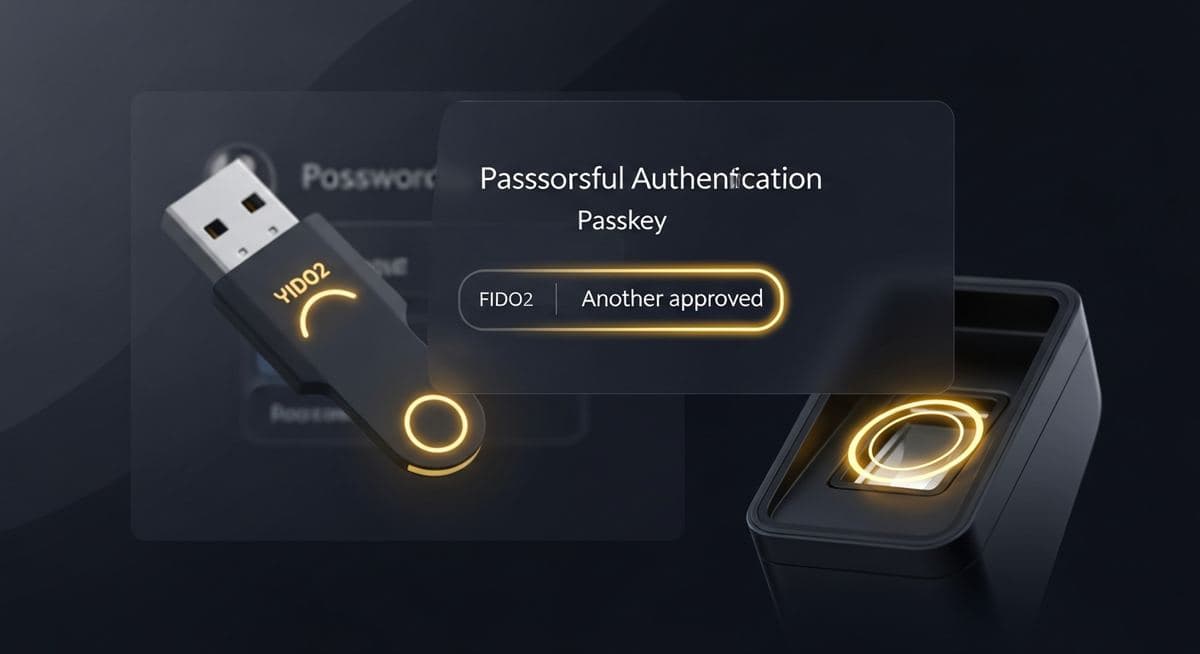
Passwordless authentication has moved from emerging technology to mainstream business deployment. FIDO2 security keys, platform authenticators (Windows Hello, Touch ID, Face ID), and passkeys are now broadly supported across major identity platforms. The question isn't whether passwordless is real — it is — but whether your business should make the move now and how to sequence it. Here's an honest look at where passwordless is ready, where it isn't, and what a realistic adoption path looks like for SMB and mid-market businesses.
What Passwordless Actually Means
The term "passwordless" covers several technologies that share one attribute: the user signs in without entering a typed password. Implementations include:
- FIDO2 security keys — physical USB or NFC devices (YubiKey, Feitian, Google Titan) that prove possession via cryptographic challenge-response
- Platform authenticators — biometric or PIN-protected hardware capabilities built into devices (Windows Hello, Touch ID, Face ID)
- Passkeys — FIDO2 credentials synced through Apple iCloud Keychain, Google Password Manager, or Microsoft account, providing portability across the user's devices
- Push-based mobile authenticators — apps like Microsoft Authenticator that accept sign-in approvals on a registered phone
All of these are stronger than typed passwords because they resist phishing — the credential is bound to the legitimate site through cryptographic verification, so a user can't be tricked into approving sign-in on a lookalike domain.
Where Passwordless Is Ready Today
The infrastructure to support passwordless is in place for most business workloads. Microsoft Entra ID (formerly Azure AD), Google Workspace, Okta, Duo, and other major identity providers all support FIDO2 and passkey-based authentication. Major business SaaS applications either support direct passwordless sign-in or accept federated authentication from these identity providers. For an organization that runs its identity stack on a modern platform, the technical capability to roll out passwordless to the majority of users exists.
The practical readiness assessment: if your users sign into their applications primarily through SSO from a single identity provider, you can deploy passwordless to most accounts in a quarter or less. If users still sign into many systems with locally-managed credentials, passwordless requires federation work first.
Where Gaps Remain
Realistic limits: not every application supports modern authentication standards. Legacy systems that only accept username/password — common in healthcare, manufacturing, and some financial systems — can't go fully passwordless without modernization. Shared device scenarios (kiosks, retail terminals, shop floor equipment) can be made passwordless but require careful design. Customer-facing authentication (your customers signing into your applications) is moving toward passkeys but adoption is uneven; planning customer authentication around passwordless-only is premature for most businesses.
The Adoption Path That Works
The deployment sequence that produces successful passwordless rollouts at SMBs:
- Phase 1 — Strengthen MFA — replace SMS and voice-based MFA with phishing-resistant MFA (security keys for high-privilege accounts, platform authenticators for general workforce). This alone delivers substantial security improvement.
- Phase 2 — Enable passwordless for SSO-connected apps — users sign into the identity provider without a password, and SSO carries them through to apps
- Phase 3 — Federate remaining apps — work down the inventory of apps still using direct password authentication, federating each to the identity provider
- Phase 4 — Restrict password fallback — once enough apps are federated, restrict password-based authentication entirely for users who have passwordless registered
The first two phases produce most of the security benefit; the latter phases are about removing the last attack surface.
The ROI Case
Passwordless reduces three categories of cost: password reset support tickets (typically 20-40% of helpdesk volume), credential phishing breach risk (the single most common breach root cause), and the cyber insurance premium impact of weak authentication controls. For a 100-person business, the combined value typically exceeds the implementation cost in year one. For larger businesses, the payback is faster. If you're scoping a passwordless rollout, a conversation with our team can map your current identity environment against the phased adoption path.
Leonidas is a managed IT services provider, cybersecurity consulting firm, and unified communications consultancy serving businesses across industries. We offer free 30-minute assessments. Contact us or call +1 (888) 790-8777.