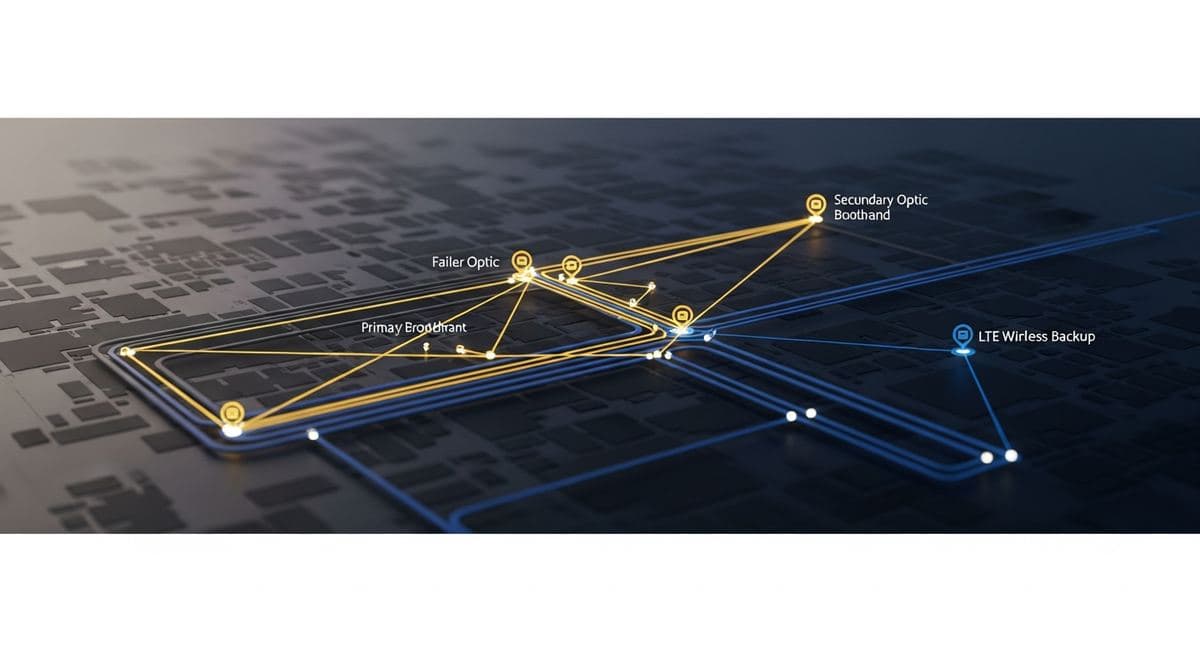
Multi-carrier WAN is the principle that no business should depend on a single internet service provider for connectivity, because every ISP eventually fails. The question isn't whether your primary carrier will have an outage — they will — but whether your business keeps operating when it happens. A well-designed multi-carrier WAN strategy turns a single point of failure into a resilient connectivity layer that fails over automatically, often without users noticing. Here's how to think about it.
The Math on ISP Reliability
Even the best business-class internet carriers operate at roughly 99.9% uptime, which sounds great until you do the arithmetic: 99.9% uptime is 8.76 hours of downtime per year. For a business that bills by the hour or processes transactions in real time, that's not acceptable. And 99.9% is the published target — real-world numbers, particularly for regional or last-mile fiber providers, often run worse. Add in scheduled maintenance windows, last-mile fiber cuts from construction, and regional outages, and a single-carrier WAN has more downtime risk than most business continuity plans acknowledge.
Multi-carrier WAN solves this by combining two or more carriers on diverse physical paths. When the primary fails, traffic flows over the secondary. With modern SD-WAN technology, the failover happens in seconds, not minutes, and is invisible to most application traffic — voice calls hold up, video conferences continue, and users don't open a support ticket.

Active-Active vs. Active-Passive
There are two architectures for multi-carrier WAN, and the right choice depends on your traffic profile:
- Active-passive — one carrier handles all traffic until it fails, then the second takes over. This is the older model, common with traditional dual-WAN firewalls. It's simpler and cheaper but you're paying for a backup circuit that's idle 99% of the time.
- Active-active — both carriers carry traffic simultaneously, with SD-WAN policy steering specific applications across specific paths. Voice and video preferentially use the lowest-latency carrier; bulk transfers use whichever has bandwidth. When one fails, the other absorbs everything. This is the modern standard.
Active-active produces meaningfully better performance day-to-day, not just during outages, because you're using both circuits' aggregate bandwidth and routing latency-sensitive traffic over the best path. The downside is complexity — SD-WAN policy needs ongoing tuning as application mix changes.
Carrier Diversity Matters More Than Carrier Count
Two carriers is not automatically two paths. If both your "diverse" carriers ultimately ride the same fiber bundle through the same conduit to the same regional handoff point, a single backhoe takes you down. Real diversity requires verifying physical path separation: different fiber providers using different routes into the building, ideally entering from different sides, with the secondary using a fundamentally different medium where possible (a fiber primary with a cellular or fixed wireless secondary, for example).
The most resilient designs we build at Leonidas typically combine a fiber primary, a fiber secondary from a different provider on a different physical path, and a cellular tertiary for last-resort failover. The cellular tertiary covers scenarios where the entire building's wired infrastructure is unavailable — common during major construction or building-wide power events that take down the cross-connect room.
What Makes Multi-Carrier WAN Actually Work
The technology is the easy part. What separates resilient WANs from theoretically-resilient WANs is operational discipline: regularly testing failover (don't wait for the outage to discover the secondary doesn't actually carry traffic), monitoring both circuits' performance independently, tracking which provider is escalating to whom when problems happen, and maintaining current contracts at both carriers so neither lapses.
Practical recommendation: schedule a quarterly failover test. Cut the primary deliberately, verify the secondary picks up correctly, document any application that didn't fail over cleanly, and fix it before the unplanned outage exposes the same issue. Businesses that run this drill don't have failover surprises during real outages; businesses that don't, do. If you're not sure whether your current WAN would survive a primary outage, a network resilience review is a quick way to find out before the outage finds out for you.
Leonidas is a managed IT services provider, cybersecurity consulting firm, and unified communications consultancy serving businesses across industries. We offer free 30-minute assessments. Contact us or call +1 (888) 790-8777.