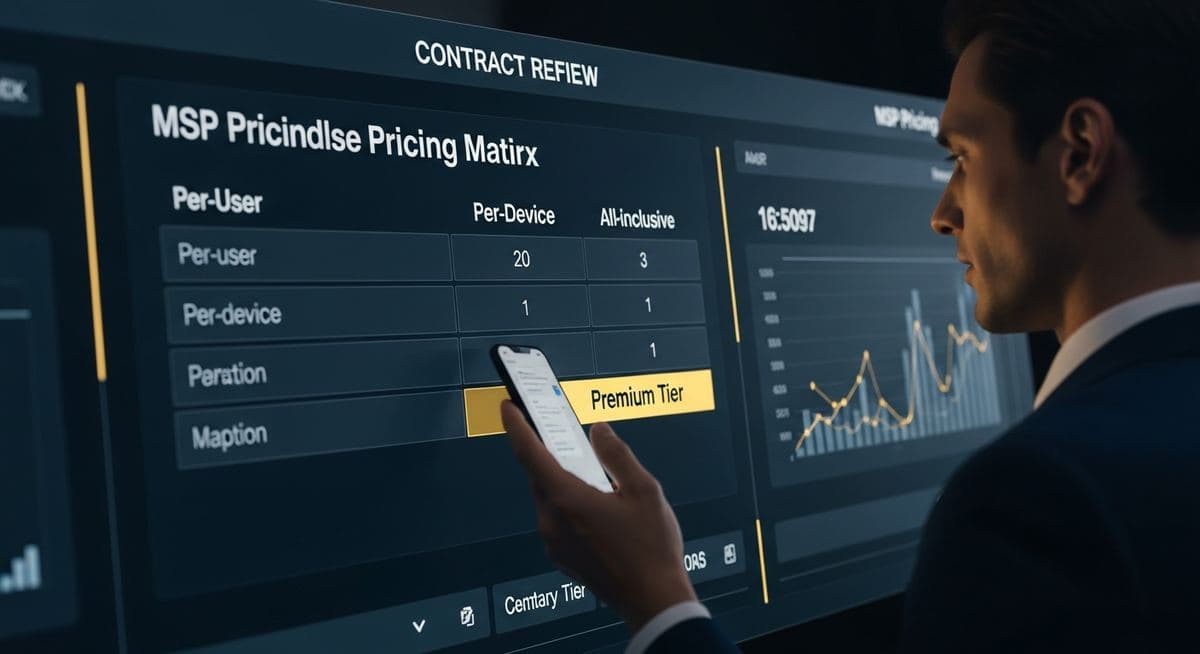
MSP pricing models have evolved past the per-device flat-rate origins of the industry into a varied landscape that can be confusing to compare. The headline rate matters less than the structure of what's covered, what's billable above it, and how the relationship scales as the business grows. Here's a practical guide to the common models, what each is designed for, and how to read past the marketing to the actual economics.
The Common Pricing Models
Most MSPs use some version of one of these structures, often in combination:
- Per-device — flat monthly fee per managed endpoint or server. Simple to understand, scales linearly with device count, doesn't capture variability in user complexity
- Per-user — flat monthly fee per managed user regardless of device count. Better fits modern multi-device per-user reality
- Tiered all-you-can-eat — a single rate that covers a defined scope of services with unlimited use within that scope. Predictable but priced for risk; the MSP builds margin for heavy-use customers into the rate everyone pays
- Block hours — purchase blocks of support time at a discounted hourly rate. Bridges between break-fix and managed services
- Hybrid — base retainer covering specific services with billable hours for work outside the defined scope. Currently the most common SMB structure
None of these is objectively better than others — the right structure depends on the customer's risk tolerance, predictability needs, and usage patterns.
What You're Really Paying For
Regardless of how the price is structured, the cost categories an MSP is covering are similar:
- Tooling — RMM platforms, ticketing systems, security tools, monitoring infrastructure
- Labor — engineers, support staff, account managers, leadership
- Operational overhead — training, documentation, compliance, certifications
- Risk and margin — provision for unexpected work, business overhead, profit margin
Headline rates that look much lower than the market are usually achieving that by cutting one of these categories — most often labor cost (lower-paid or less-experienced engineers, offshore tier-one support, higher engineer-to-customer ratios). The cost shows up as service quality differences later.
The Hidden Cost: What's "Out of Scope"
The biggest variable in MSP economics isn't the headline rate — it's what's billable above the retainer. Common categories that vary wildly between providers:
- After-hours support
- On-site visits
- Project work (cloud migrations, infrastructure changes, security uplifts)
- Equipment procurement and configuration
- Onboarding for new users (account creation, machine setup)
- Offboarding for departing users
- Vendor coordination
- Compliance documentation
- Hardware refreshes
- Software license management
A "low rate" with everything above the line being billable can end up more expensive than a higher rate with broad inclusion. Comparing offers requires a clear view of what's inside and outside each provider's scope.
How to Compare Apples to Apples
The framework for honest MSP price comparison:
Estimate your annual support load — tickets, projects, new-user onboarding, equipment changes, after-hours incidents. Get specific numbers from your current operations if you have history; estimate from headcount and complexity if you don't. Apply each provider's pricing model to that load. Some will look cheaper on the retainer but expensive on the variable; others the reverse. Total annual cost is what to compare, not monthly retainer alone. Then weight by the qualitative factors — service quality, team tenure, security posture, references — that the price comparison doesn't capture directly.
What Good Pricing Looks Like
A well-structured MSP relationship has these attributes regardless of model: clear definition of what's included and what's billable, transparent rate cards for billable work, predictable handling of growth (new users, new devices, new locations), capped price increases at renewal, alignment between provider incentives and customer outcomes (provider doesn't make more money by creating more problems), and willingness to walk through the economics openly. If you're scoping MSP pricing for a renewal or a new relationship, a conversation with our team can help calibrate what you should be paying for the service quality you need.
Leonidas is a managed IT services provider, cybersecurity consulting firm, and unified communications consultancy serving businesses across industries. We offer free 30-minute assessments. Contact us or call +1 (888) 790-8777.