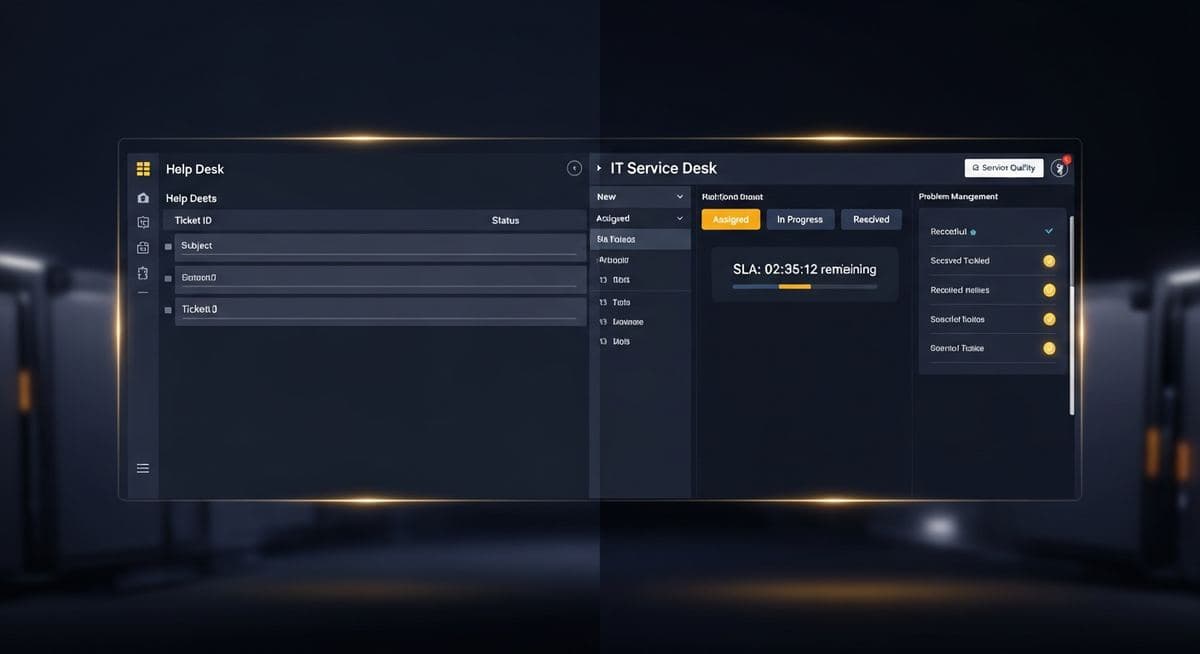
Help desk vs. service desk sounds like marketing jargon, but the operational difference matters when you're choosing between IT support models. The terms get used interchangeably in casual conversation, but in the IT services world they describe different scopes and capabilities. Knowing the difference helps frame what you're actually buying when you contract with an MSP — and what you should expect.
The Distinction
A help desk is primarily reactive and incident-focused. It handles user-reported problems: "my computer won't start," "I can't log in," "my printer isn't working." The scope is usually limited to common technical issues that have well-known resolutions. The metrics that matter are response time, first-call resolution rate, and ticket volume.
A service desk is broader, including incident handling but also service requests (new account creation, software installation, access changes), problem management (identifying patterns across multiple incidents), change coordination (scheduled work that affects users), and knowledge management (capturing resolutions so future occurrences resolve faster). A service desk operates against ITIL-style processes; a help desk often doesn't.
In practice, the line is fuzzy. Many small business "help desks" actually function as service desks; some "service desks" don't deliver on the broader scope. The label matters less than what's actually being done.
What Most SMBs Actually Need
For small businesses with under 50 users, a help desk model usually covers the operational reality — reactive support for the things that go wrong day-to-day. The ITIL-style overhead of a formal service desk doesn't add proportional value at that scale.
For mid-market businesses (50-500 users), the service desk capabilities start mattering: service requests become high-volume enough that a defined process is worth having, problem management becomes valuable as repeated incident patterns emerge, and change coordination prevents the operational disruptions that ad-hoc work creates.
For larger businesses, full ITIL-aligned service desk is typically required — both operationally (to handle the volume and complexity) and from a compliance standpoint (frameworks like SOC 2 expect documented service management practices).
The Quality Markers Beyond the Label
Regardless of whether you're hiring a help desk or service desk, the quality markers that distinguish good from average:
- First-touch resolution rate — what percentage of tickets resolve without escalation? Higher is better; lower suggests skill gaps or scope mismatches
- Time to acknowledge — how quickly does someone respond to a new ticket? Should be measured in minutes for business-hours tickets
- Time to resolution — average across priority levels. Should be tracked and reportable
- Customer satisfaction (CSAT) — survey-based measurement of user experience with each ticket interaction
- Recurrence rate — how often does the same user submit the same issue? High recurrence suggests root cause isn't being addressed
- Knowledge base coverage — for repeated issues, is there documentation that users can self-serve? A good service desk grows its knowledge base; a help desk often doesn't.
The Hidden Cost Comparison
Help desks tend to look cheaper on the surface — lower per-user pricing, simpler scope. Service desks cost more per user but typically deliver more value:
- Reduced incident recurrence through problem management
- Higher first-touch resolution through better knowledge management
- Less disruption from changes through proper change coordination
- Better metrics and reporting to identify operational issues
- Cleaner audit trail for compliance scenarios
At businesses where IT support quality affects productivity meaningfully, the service desk premium typically pays back through productivity recovery. At businesses where users have low support needs and IT is mostly self-sufficient, help desk is enough.
What to Ask When You're Buying
The questions that tell you what you're actually getting: how do you handle service requests vs. incidents? What's your process for identifying repeated patterns? How do you coordinate changes that affect users? What does your knowledge management practice look like? What metrics do you report, and how often?
If the answers describe defined processes, the offer is a service desk regardless of how it's labeled. If the answers are vague or focus only on "we'll fix whatever breaks," you're being offered a help desk. Match the offer to your actual operational needs. A conversation with our team can help frame what level of support fits your environment.
Leonidas is a managed IT services provider, cybersecurity consulting firm, and unified communications consultancy serving businesses across industries. We offer free 30-minute assessments. Contact us or call +1 (888) 790-8777.