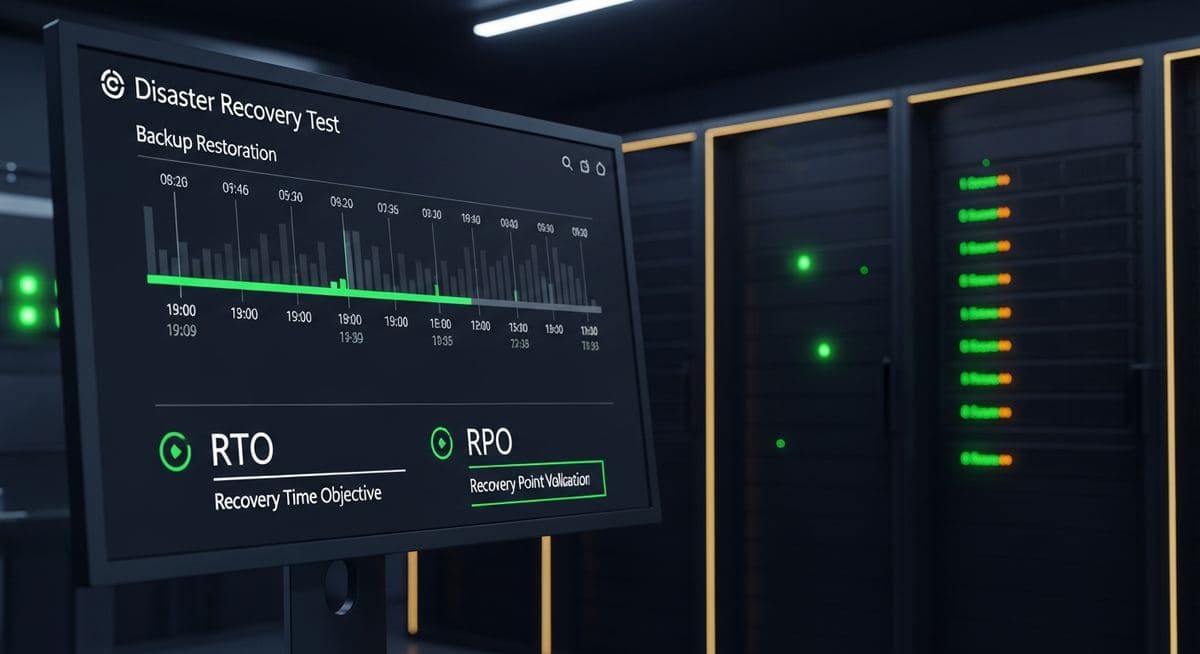
Disaster recovery testing is the difference between having backups and being able to recover. The two are not the same. Businesses that have never tested a restoration discover gaps when an actual disaster happens — at the worst possible moment. The good news is that disaster recovery testing isn't difficult; it just requires the discipline to actually do it on a regular schedule. Here's what a real DR test looks like, what it catches, and how to fit it into a busy operations calendar.
What Counts as a DR Test (and What Doesn't)
The minimum bar for a meaningful DR test: an actual restoration of data from a backup to a working system, verified by someone using that system to perform business operations. Lower bars don't count. Verifying the backup completed successfully isn't a test. Looking at the backup software's "validation passed" indicator isn't a test. Spot-checking that the backup files exist isn't a test. Restoring data and confirming applications work with that data is a test.
Why the bar matters: backups can complete and validate successfully, and the restored data can still be unusable — corrupted, incomplete, missing referential integrity, or in a format the current application version can't read. These failures are caught by restoration testing and only by restoration testing.
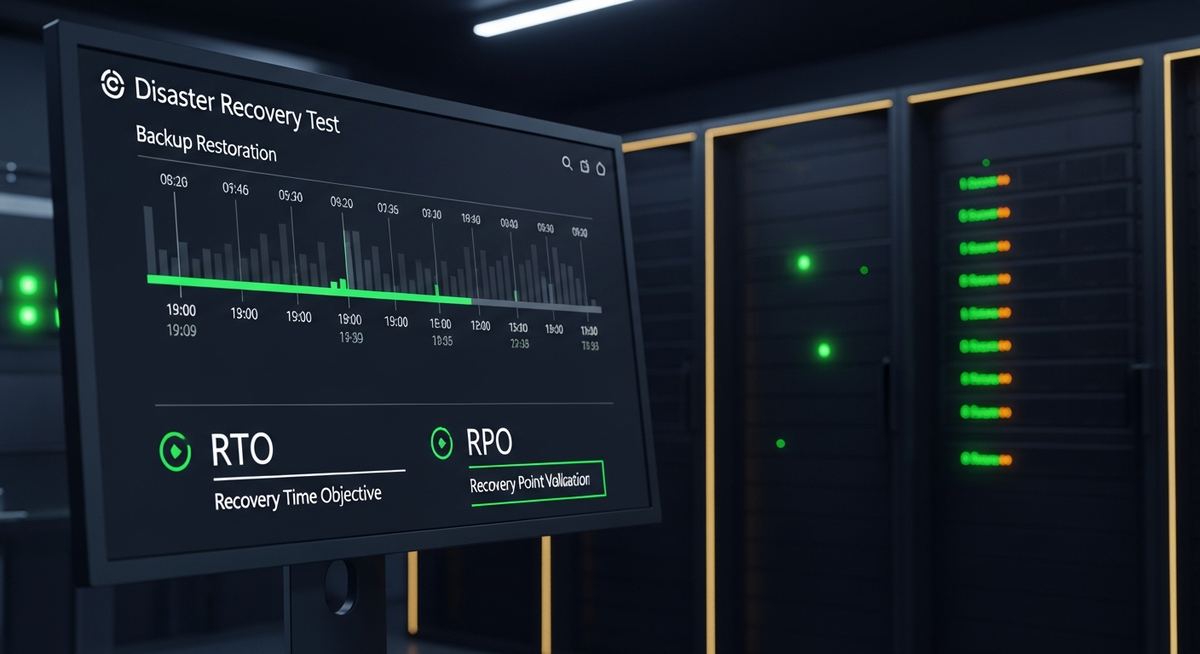
The Test Cadence That Catches Real Problems
The test cadence that consistently catches problems before they cause damage:
- Monthly — partial restoration of a sample of files or a single virtual machine. Quick, low-cost, catches basic backup corruption
- Quarterly — restoration of a representative application stack to a test environment. Validates that applications start, accept the restored data, and perform basic operations
- Annually — full DR exercise simulating loss of the primary environment. Failover to secondary infrastructure, verification that critical business processes function, documentation of any gaps discovered
The annual exercise is where the operational gaps show up. Documentation that's wrong, runbooks that reference systems no longer in use, dependencies that the team didn't realize existed. The first annual exercise usually finds dozens of issues; subsequent exercises catch fewer because the previous ones drove fixes.
What Tests Typically Find
Patterns we see consistently in DR tests:
- Backups exist but the documented restoration procedure doesn't actually work — usually because the procedure was written years ago and the environment has changed
- Critical dependencies (license servers, authentication services, name resolution) aren't in scope for DR, so when the primary fails the secondary can't function
- Backup retention windows are too short for the actual recovery scenarios that matter — incidents discovered weeks after they started can't be recovered from
- Recovery times exceed the documented RTO by significant margins because no one ever measured
- Restored data lacks the third-party integrations that production has, so applications work but don't connect to anything
- Knowledge required to run the recovery sits with one person who's not always available
How to Fit Testing Into Operations
The most common reason DR testing doesn't happen consistently is that no one has time. Practical ways to make it work: schedule the monthly partial test as a recurring calendar event with an owner who actually performs it, build the quarterly application test into the operational cadence with documented success criteria, plan the annual exercise as a quarter's-worth of preparation plus a single-day or two-day execution, treat the gaps surfaced by tests as priority operational work rather than as a backlog item to address "soon," and report DR test results to leadership so the practice has visibility.
The Value Beyond Disaster
DR testing produces value even when no disaster occurs. Cyber insurance underwriters increasingly ask about DR testing as part of underwriting; documented evidence of regular testing improves coverage and pricing. Regulatory frameworks (HIPAA, SOC 2, CMMC) require it. Internal confidence in the IT operation increases when restoration capability is proven rather than assumed. And the operational discipline DR testing requires — clean runbooks, current documentation, defined RTOs — improves daily operations independent of disaster scenarios. If your business hasn't tested a real restoration in the past quarter, that's the next operational investment that pays back fastest. A conversation with our team can scope a DR test plan for your environment.
Leonidas is a managed IT services provider, cybersecurity consulting firm, and unified communications consultancy serving businesses across industries. We offer free 30-minute assessments. Contact us or call +1 (888) 790-8777.