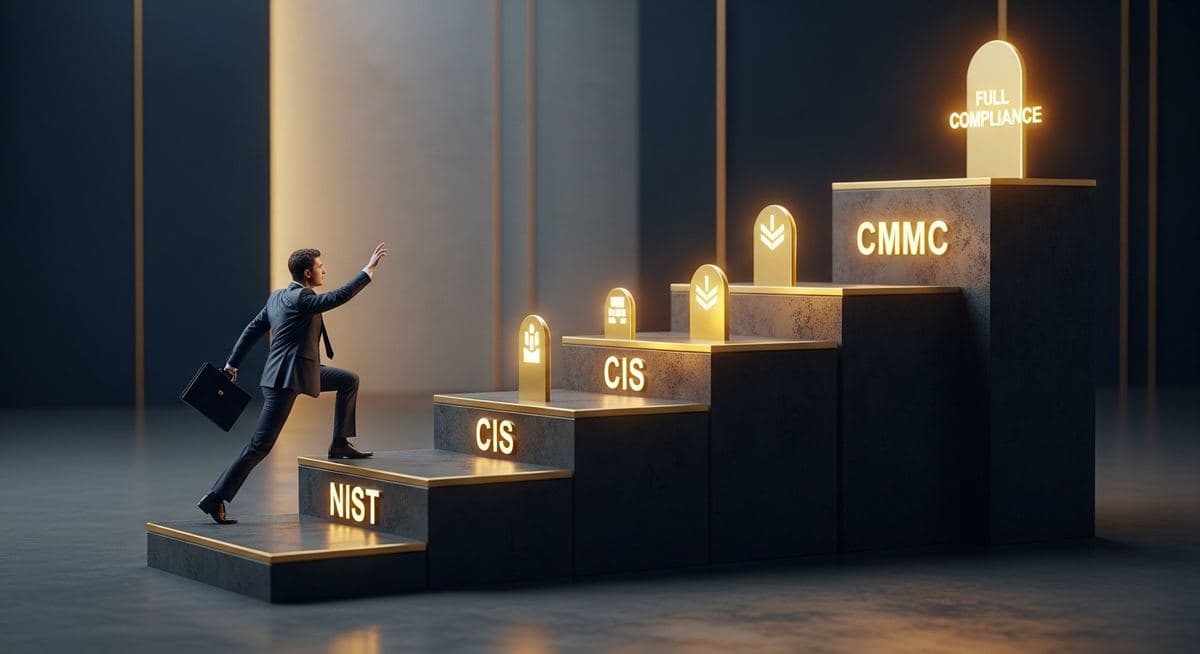
Compliance frameworks NIST, CIS, and CMMC often get discussed together because they're related but distinct. NIST publishes the underlying control catalog; CIS Controls organizes a prioritized subset of those into actionable guidance; CMMC builds on NIST 800-171 to create certification requirements for defense contractors. Understanding how they relate — and which one applies in which situation — saves substantial confusion. Here's the practical breakdown.
NIST: The Underlying Standard
The National Institute of Standards and Technology publishes the foundational cybersecurity standards used across US federal contexts and increasingly the private sector. The most relevant NIST publications:
- NIST CSF (Cybersecurity Framework) — high-level framework organizing security work into five functions (Identify, Protect, Detect, Respond, Recover). Voluntary, widely adopted, applicable to any organization.
- NIST SP 800-53 — detailed control catalog used by federal agencies. Extensive (over 1,000 controls across many categories) and rigorous.
- NIST SP 800-171 — subset of 800-53 controls applicable to non-federal organizations handling Controlled Unclassified Information (CUI). The foundation for CMMC.
- NIST SP 800-66 — guidance for HIPAA Security Rule implementation
For most SMBs, NIST CSF is the relevant framework — flexible, widely understood, and not requiring certification.

CIS Controls: The Actionable Prioritization
The Center for Internet Security maintains the CIS Controls (currently version 8), a prioritized list of 18 controls that cover the most impactful security activities. Two attributes make CIS Controls particularly useful:
- Prioritized — controls ordered by impact, with Implementation Groups 1, 2, and 3 corresponding to increasing organizational scale and risk profile. Most SMBs target IG1 first.
- Actionable — each control has specific safeguards with clear implementation guidance
For SMBs starting security framework adoption, CIS Controls is usually the right place to begin. It maps to NIST CSF and other frameworks, so adopting CIS doesn't lock you into a single framework — it gives you a prioritized implementation path.
CMMC: The Certification for DoD Contractors
The Cybersecurity Maturity Model Certification is the specific framework required for Department of Defense contractors. CMMC builds on NIST SP 800-171 to create three certification levels:
- Level 1 (Foundational) — basic safeguards for Federal Contract Information; self-assessment
- Level 2 (Advanced) — NIST SP 800-171 aligned; required for handling Controlled Unclassified Information; third-party assessment
- Level 3 (Expert) — additional controls for highest-sensitivity work; government-led assessment
The current rollout means CMMC requirements increasingly appear in DoD contracts. Businesses in the defense supply chain need to know their required level and prepare accordingly. Preparation typically takes 9-18 months from start to certification.
How They Fit Together
The relationship between the three:
NIST CSF provides the high-level organizing framework. CIS Controls provides a prioritized, actionable subset that operationalizes NIST CSF for typical organizations. CMMC builds on NIST 800-171 to create certification requirements for a specific compliance context.
For an SMB without specific DoD contracting requirements: CIS Controls is the primary operating framework, with NIST CSF as the communication framework for executive reporting. CMMC isn't relevant unless DoD contracts are in the business mix.
For an SMB with DoD contracts: CMMC requirements drive the work, with the underlying NIST 800-171 controls being the actual implementation. CIS Controls work can map into and accelerate the CMMC preparation.
The Implementation Reality
Framework adoption matters most operationally, not as paperwork. The pattern that produces value:
- Pick the framework that fits your situation
- Build a current-state assessment of where you are against the framework
- Identify the priority gaps
- Implement controls progressively, with measurable progress
- Maintain the controls operationally, with regular review
- Update documentation to match operational reality
The pattern that doesn't: producing thick documentation of framework alignment that doesn't reflect what's actually happening operationally. Paper compliance fails when incidents happen.
For SMBs Considering Framework Adoption
Practical recommendation for businesses without specific compliance drivers: start with CIS Controls IG1, work systematically through the implementation, and report progress against NIST CSF for executive visibility. This produces real security improvement without certification overhead. If certification (SOC 2, ISO 27001, HITRUST, CMMC) is needed later, the CIS Controls work translates directly into those frameworks' requirements. A conversation with our team can help frame which framework adoption fits your situation.
Leonidas is a managed IT services provider, cybersecurity consulting firm, and unified communications consultancy serving businesses across industries. We offer free 30-minute assessments for businesses evaluating their IT and security posture. Contact us or call +1 (888) 790-8777.