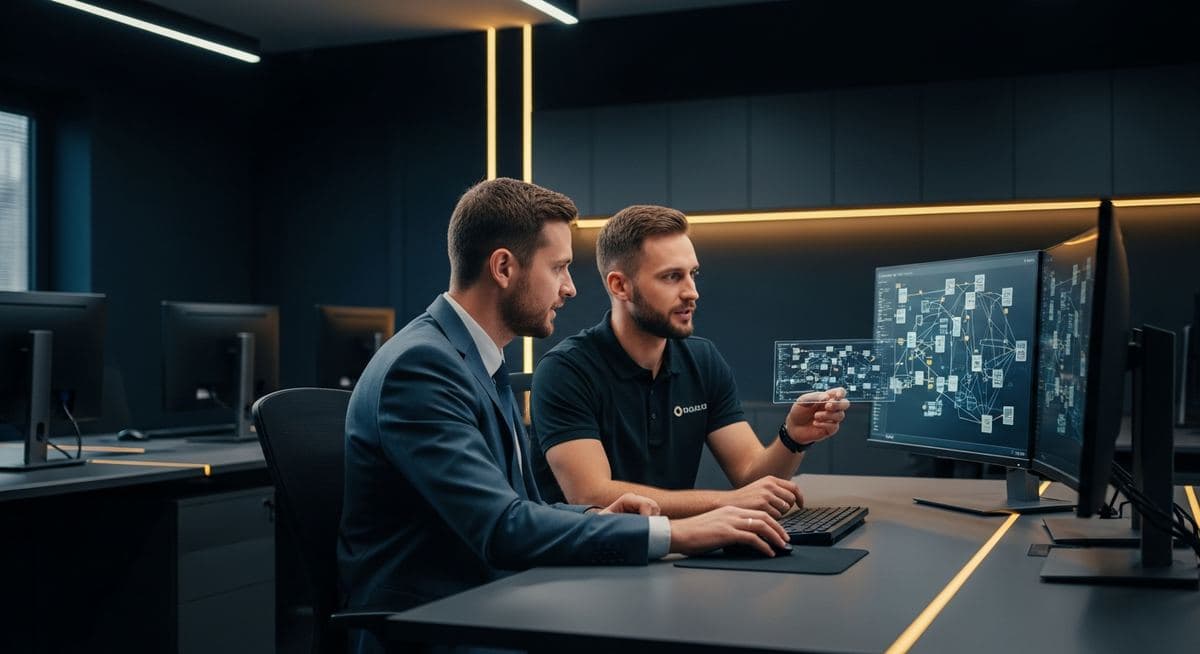

Co-Managed IT Services — The fully outsourced IT model — where an MSP handles everything and the business has no internal IT staff — works well for many small organizations. But as businesses grow, or when they already have an IT employee or small team in place, the calculus changes. Co-managed IT is the model designed for this situation: a partnership between an internal IT function and an external provider, with each handling what they do best.
What Co-Managed IT Actually Means
Co-managed IT isn't a vague concept — it's a structured service model with a clear division of responsibilities. Typically:
- Internal IT team handles: day-to-day helpdesk and user support, on-site troubleshooting, physical hardware management, user onboarding and offboarding, internal project work
- MSP provides: 24/7 monitoring and alerting, security operations and threat response, specialized expertise (network engineering, cybersecurity, UCaaS) not available internally, after-hours and overflow helpdesk coverage, backup and disaster recovery management, strategic advisory and vendor management
The exact split depends on what the internal team can handle and where the gaps are. A good co-managed arrangement is built around the internal team's actual capabilities, not a standard package.
When Co-Managed IT Makes Sense
The model works best in a few specific situations:
- You have one IT person doing everything — a single IT employee is often one vacation, one resignation, or one sick day away from a serious coverage gap. Co-managed IT provides backup expertise and coverage without adding headcount.
- Your internal team lacks specialized skills — a generalist IT person is valuable but has limits. Cybersecurity, advanced networking, and UCaaS require depth that's difficult for a generalist to maintain. Co-managed IT fills those specific gaps.
- You need after-hours coverage without hiring for it — 24/7 monitoring and after-hours response requires either significant staffing or a partner. Co-managed IT provides this at a fraction of the cost of additional employees.
- You're growing faster than your internal IT capacity — adding headcount has a long lead time. Co-managed IT scales immediately.
What Co-Managed IT Is Not
Co-managed IT is not a replacement for having internal IT capacity — it's a supplement. If your internal IT team is a liability rather than an asset, co-managed IT amplifies that problem rather than solving it. The model requires a functional internal team that the external provider can partner with effectively.
It's also not a cost-saving measure compared to a well-resourced internal team doing everything well. For large organizations with mature internal IT departments, co-managed IT adds value in specific niches (security operations, specialized projects) rather than across the board.

How to Structure the Engagement
The most common friction in co-managed IT arrangements is ambiguity about who owns what. Avoiding this requires explicit documentation at the start:
- A clear RACI matrix (Responsible, Accountable, Consulted, Informed) for every significant function
- Defined escalation paths — when does the internal team escalate to the MSP, and what's the expected response?
- Shared tooling — the MSP's RMM and ticketing systems should give the internal team visibility, not operate as a black box
- Regular cadence — monthly or quarterly touchpoints between internal IT leadership and the MSP account team to review open items, upcoming projects, and performance
If you have internal IT staff and are wondering whether a co-managed arrangement would give you better coverage and capability than you have today, Leonidas offers this model and would be glad to walk through what it would look like for your specific situation.
Leonidas is a managed IT services provider, cybersecurity consulting firm, and unified communications consultancy serving businesses across industries. We offer free 30-minute assessments for businesses evaluating their IT and security posture. Contact us or call +1 (888) 790-8777.