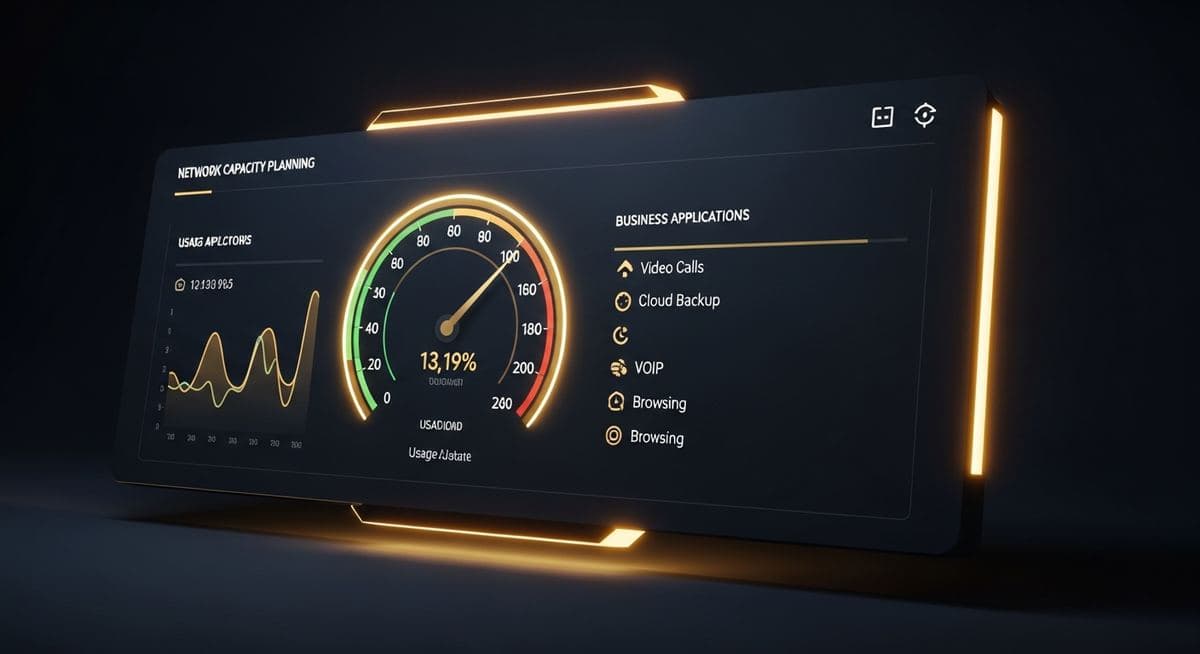
Business internet bandwidth is the question every IT decision-maker eventually has to answer, usually right before signing a new circuit contract: how much do we actually need? The honest answer is that most businesses are either overbought (paying for capacity they never use) or underbought (suffering performance problems on calls and SaaS) — but the calculation isn't hard once you understand which applications are bandwidth-sensitive and which are latency-sensitive. Here's a practical sizing framework.
Bandwidth vs. Latency: They Are Not the Same
A common mistake is to assume that more bandwidth solves all internet performance problems. It doesn't. Bandwidth (measured in Mbps or Gbps) determines how much data can flow at once. Latency (measured in milliseconds) determines how quickly a packet gets from your office to a server and back. Some applications care primarily about bandwidth — file transfers, video streaming, backup to cloud. Others care primarily about latency — VoIP calls, video conferencing, real-time SaaS interactions, remote desktop. Buying a 10 Gbps circuit with high latency will not fix a VoIP problem. Buying a 100 Mbps low-latency circuit will not fix slow cloud backups.
Modern business connectivity needs adequate bandwidth AND low, consistent latency. The bandwidth number is what gets quoted; the latency number is what determines whether the line actually performs well for the workloads that matter.

How to Estimate Real Bandwidth Need
The most accurate way to size a circuit is to measure existing usage. Run NetFlow or sFlow on your edge device for a week, look at peak utilization during business hours, and add headroom. If you don't have visibility into current usage yet, you can estimate from headcount and application mix:
- Email, web browsing, basic SaaS — about 1 Mbps per concurrent user
- Voice over IP (per simultaneous call) — 100 Kbps for G.711, 30 Kbps for G.729
- Video conferencing (HD) — 1.5-3 Mbps per active video stream
- Cloud file storage active sync — 5-10 Mbps per heavy user during peak sync events
- Cloud backup — varies wildly; nightly backups can saturate available upload bandwidth for hours
Multiply by your actual concurrent user count (not headcount — your 50-person office probably has 35 concurrent users during peak), add 30-50% headroom, and round up to the nearest tier the carrier offers.
Symmetric vs. Asymmetric Matters More Than It Used To
Traditional broadband connections are asymmetric — fast download, slow upload. That made sense when "the internet" meant pulling web pages from servers. Today's business workloads are increasingly upload-heavy: cloud backups, video conferences (your camera is uploading), large file shares, SaaS that constantly syncs local state to the cloud. An asymmetric 1 Gbps down / 50 Mbps up connection that looked great on paper will choke during a Zoom call with 20 people if the upload side is saturated.
For most business workloads, symmetric fiber is now the right baseline. The pricing gap between symmetric fiber and asymmetric cable has narrowed substantially in most markets, and the workload profile increasingly justifies it.
What "Enough" Actually Looks Like by Business Size
Rules of thumb based on what we typically install:
- 5-15 employees — 200-500 Mbps symmetric fiber, single circuit. Cellular failover.
- 15-50 employees — 500 Mbps to 1 Gbps symmetric fiber, single circuit with secondary failover.
- 50-150 employees — 1 Gbps symmetric primary plus 500 Mbps to 1 Gbps secondary on a diverse carrier, active-active SD-WAN.
- 150+ employees or heavy cloud workloads — multiple gigabit circuits, multi-carrier diverse paths, dedicated internet access (DIA) for SLA guarantees, professional WAN management.
These are starting points, not rules. Heavy users of video, real-time CAD/3D collaboration, or large-scale data analytics workloads scale up from there. Light users (small professional services firm, basic email plus a few SaaS apps) can run lighter. The right answer for your business comes from measuring rather than guessing. If you'd like help instrumenting your current usage and right-sizing, a free 30-minute assessment covers the basics.
Leonidas is a managed IT services provider, cybersecurity consulting firm, and unified communications consultancy serving businesses across industries. We offer free 30-minute assessments. Contact us or call +1 (888) 790-8777.