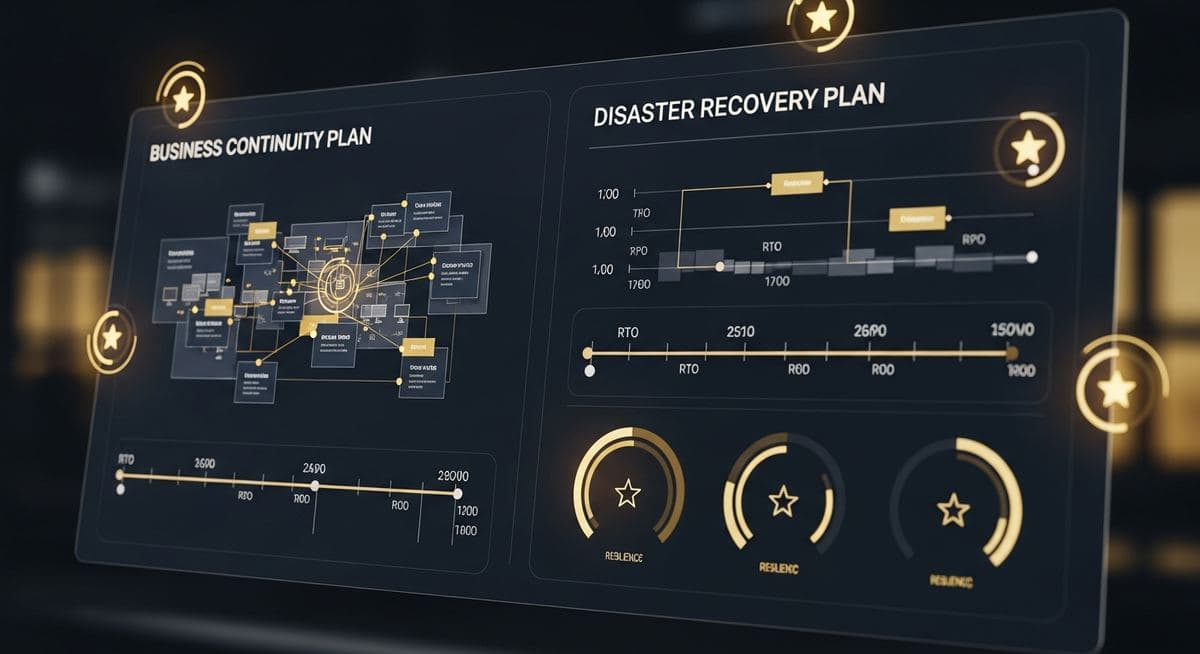
Business continuity and disaster recovery are related but distinct disciplines that businesses frequently conflate. DR is the technical capability to restore systems and data after a disruption. BC is the broader business capability to keep operating through a disruption. You need both, but they require different planning, different stakeholders, and different investments. Here's how the two fit together and where most small and mid-market businesses have gaps.
The Distinction in Practice
A simple way to see the difference: DR answers "how do we get our systems back?" BC answers "how do we keep serving customers while our systems are down?" A business that has DR but no BC can restore IT in a few hours, but during those hours, customer service stops, sales stop, and operations stop. A business with both can route around the IT disruption — using alternate communications channels, manual fallback processes, or partner support — while DR runs in parallel.
Most SMBs have some DR capability (backups, at minimum) and very little BC. The BC gap is more consequential than most business owners realize because it shows up first during any real disruption.
What DR Plans Cover
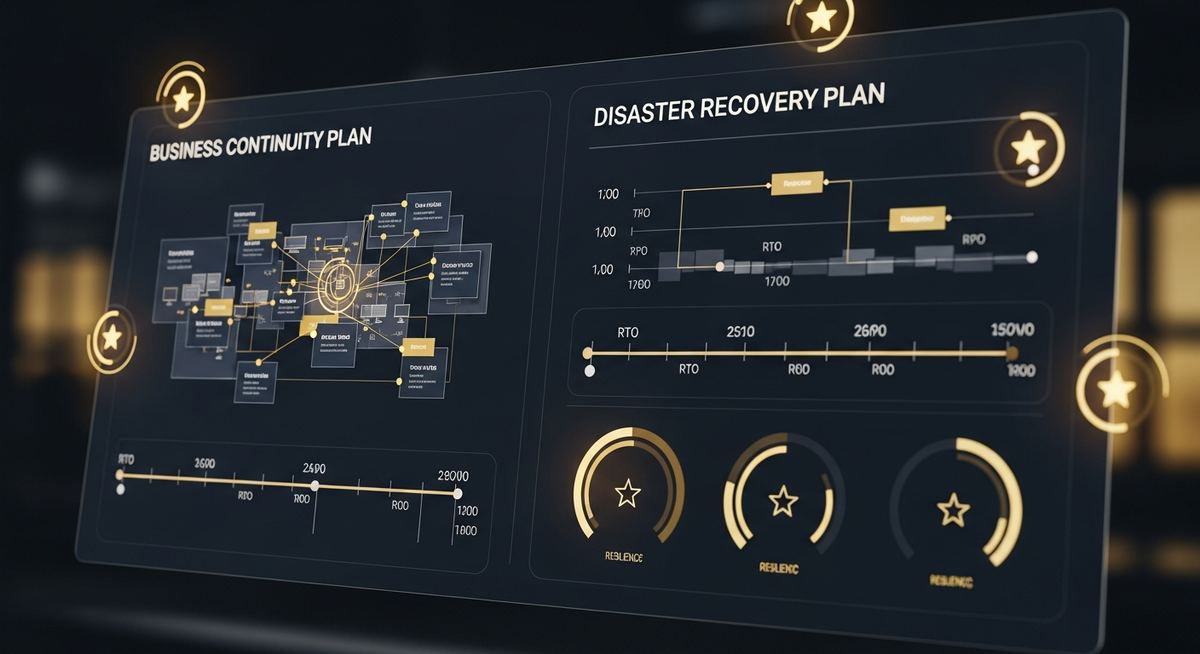
A disaster recovery plan typically includes:
- Recovery time objective (RTO) — how quickly each system needs to be restored
- Recovery point objective (RPO) — how much data loss is acceptable for each system
- Backup strategy — what's backed up, how often, where stored, how protected from ransomware
- Restoration procedures — step-by-step runbooks for restoring each system class
- Failover infrastructure — secondary environments that can take over if primary is unavailable
- Testing schedule — when restoration is verified, by whom
What BC Plans Cover
A business continuity plan addresses different questions:
- Critical business processes — what the business absolutely must continue doing during a disruption
- Process dependencies — what each critical process needs (people, systems, information, partners) to function
- Alternate workflows — how each process can run when its normal systems aren't available
- Communication procedures — how the business communicates internally and with customers during a disruption
- Decision authority — who has authority to make decisions during an incident
- Vendor and partner coordination — how external parties are engaged during a disruption
- Return to normal — how the business transitions back to standard operations
Where Most SMBs Have Gaps
The common BC/DR gaps at small and mid-market businesses:
- Backups exist but restoration has never been tested — DR exists on paper but isn't proven
- No documented BC plan at all — "we'll figure it out when something happens" is the default
- Critical-process dependencies aren't mapped, so when one system fails the business doesn't know what else stops
- Communication during incidents has no playbook — customers find out through their own attempts to reach the business
- Decision authority isn't documented, so during incidents leadership has to be assembled before anything can be decided
- BC and DR plans don't exist as a coordinated pair — the IT team has a DR plan, the business has nothing, and they aren't aligned
The Practical Path Forward
For SMBs trying to close BC/DR gaps, the sequence that produces results: start by listing the business's critical processes and what each one needs to function. For each, identify the realistic disruption scenarios and what would need to happen. Build documented response procedures for the highest-impact scenarios first. Test the procedures with tabletop exercises — walk through the disruption verbally without actually triggering one. Then formalize the test cadence and rerun it annually.
The technical DR side runs in parallel: ensure backups are immutable, restoration is tested, and recovery times match documented RTOs. The two work together — the BC plan tells you what RTOs the business actually needs; the DR plan tells you whether the current technical capability meets those RTOs.
The Compliance Driver
Even without disaster scenarios, BC/DR practices are increasingly required by compliance frameworks and cyber insurance. SOC 2, HIPAA, and CMMC all include continuity requirements. Cyber insurance underwriting routinely asks about both backup posture and business continuity capability. Building these capabilities now satisfies both immediate operational needs and the compliance ask. If you'd like help scoping a BC/DR project for your business, a conversation with our team can map the work specific to your environment.
Leonidas is a managed IT services provider, cybersecurity consulting firm, and unified communications consultancy serving businesses across industries. We offer free 30-minute assessments. Contact us or call +1 (888) 790-8777.